
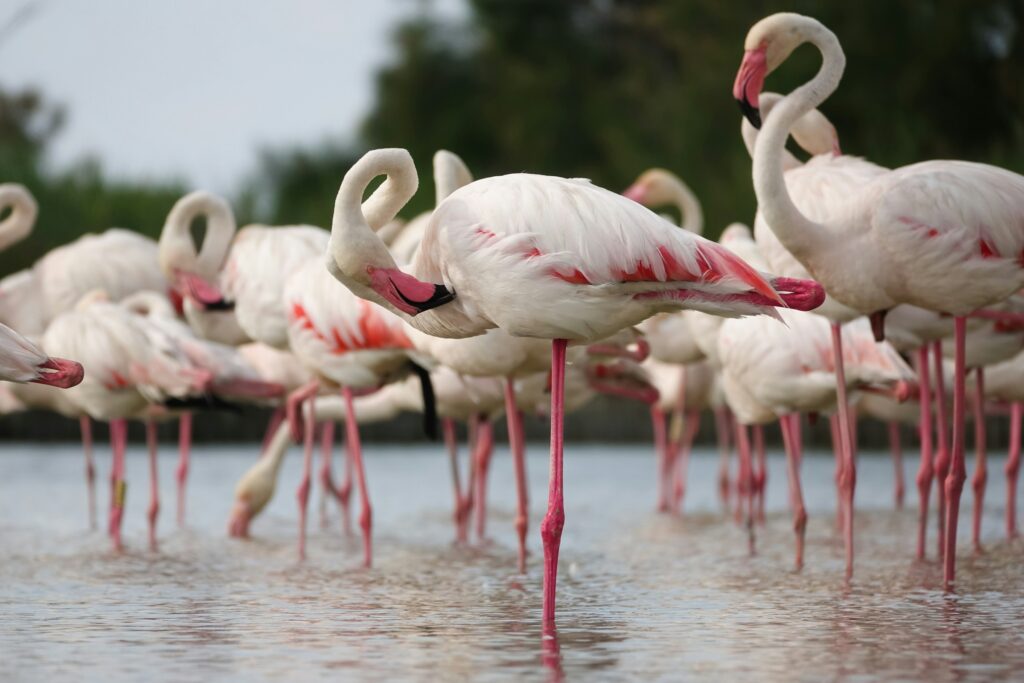
Ever wondered why Flamingos stand on one leg so often? Turns out they are cutting down on efforts!
Share this article on
Flamingos are interesting birds with tall slender legs, long curvaceous necks and attractive pink feathers. They are excellent dancers too. When they are not dancing, they are either ducking down their curvy bills under shallow waters feeding or standing on one leg snoozing. The later scene almost always plops a question down on our serene minds – Why do Flamingos stand on one leg? If not always, well, most of the time.
It’s a genuinely serious question though. Because when we try standing on one foot it never lasts for more than a few seconds for most of us. Yoga enthusiasts are a different breed altogether and should be strictly barred from entering this discussion. But for the most average ones like us standing on one foot is a difficult feat. So how do Flamingos do it with such ease?
There have been several hypotheses to explain this standing on one foot phenomenon. The most popular one though being the heat conservation hypothesis. Since the legs are not covered in feathers they act as heat radiators losing a lot of precious body heat. This can be dangerous in cold weathers and even in warm climates as the bird stands in water most of the time. A few degrees of variation in water temperature makes a huge difference in thermoregulation. So, tucking a leg in and leaving just one exposed to cold airs can reduce heat loss tremendously. Studies have shown that most Flamingos prefer standing on one leg when surrounding air temperatures are cold and when they are on water than when on land.
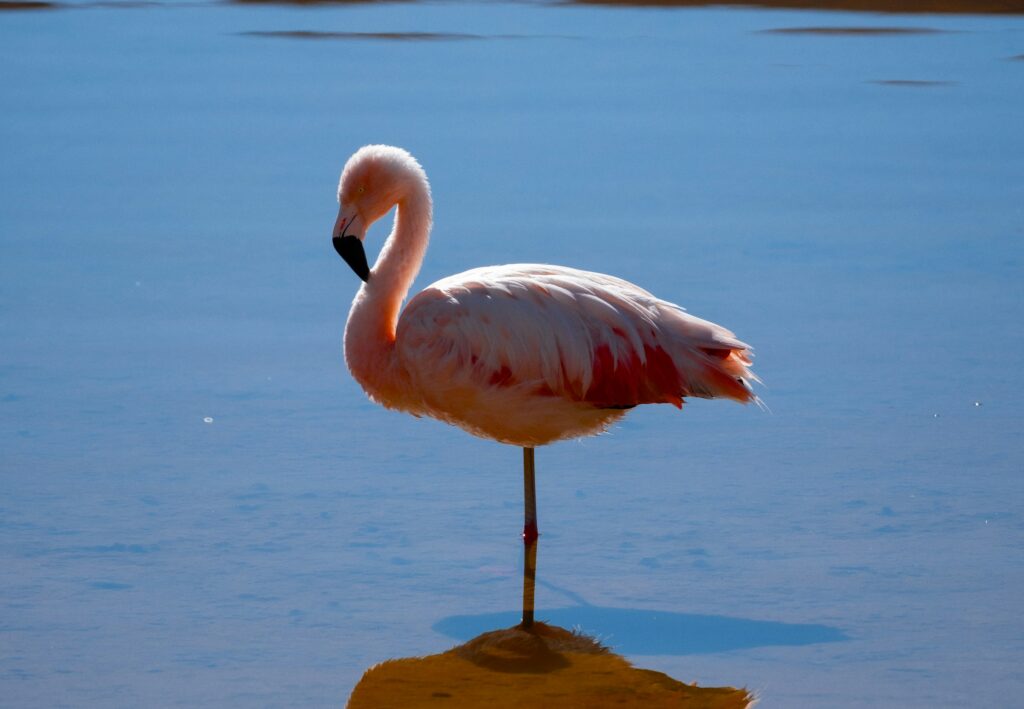
However, Flamingos face a dilemma when the days are both cold and windy. To maintain body posture and balance under strong winds Flamingos have no other option but to stand on both legs.
The second hypothesis is the muscle fatigue hypothesis which states that standing for long periods require extensive muscle effort that can fatigue the leg muscles. To avoid muscle fatigue the Flamingo stands alternatively on either foot, resting one foot intermittently as the other exerts muscle power to keep the bird standing.
Another explanation as to why Flamingos stand on one leg, may be to avoid burning the skin of their feet. The waters in a Flamingo’s habitat are highly saline and alkaline in nature. Such waters with high salt concentration can easily inflict burns on normal skins of most animals. Though the skin on a Flamingo’s feet are tough it is better to take precautionary measures by alternating between the two feet one at a time to avoid exposing them to too much salt.
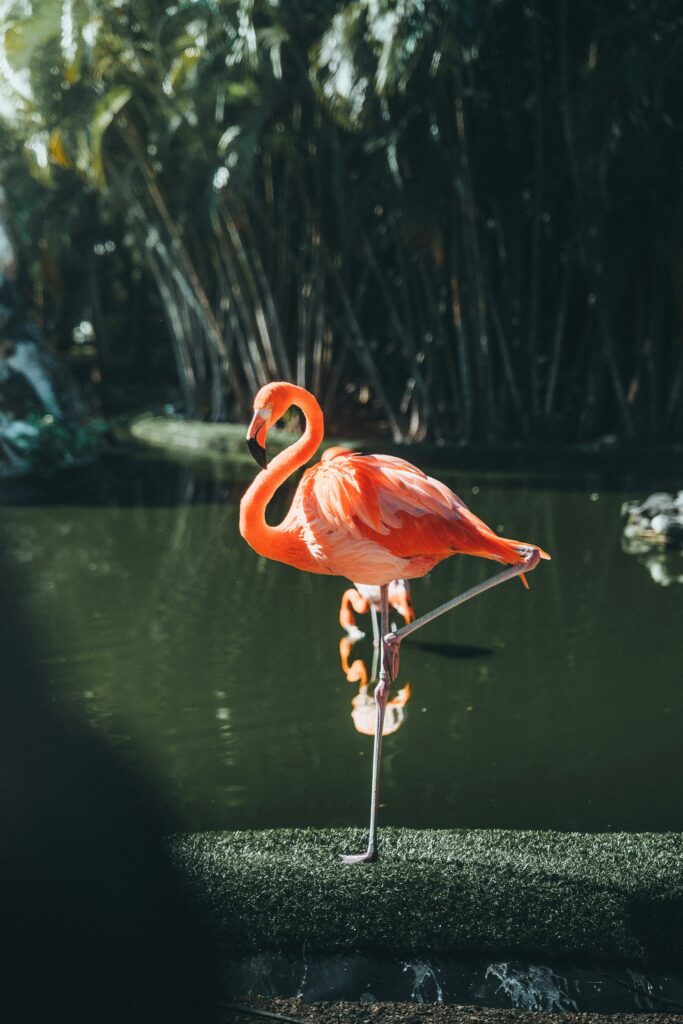
But could standing on one leg actually be effortless? As bizarre as it may sound, such is the case here. In a very elaborate study, it was found that Flamingos exert no or near zero muscle power while standing on one foot. The bird has a “stay apparatus” similar to that of a horse that enables it to stand erect on one leg without much effort.
The study examined Flamingo cadavers to analyse muscle activity and force distribution across the body in the popular one-legged Flamingo stance. They found that Flamingo cadavers could be balanced very easily while made to stand on one foot than when placed on both feet. Since cadavers do not have any active muscle activity, we may assume that any balancing act observed in the one-legged posture is involuntary. While the two-legged position requires active muscle function which is why cadavers could not be stabilised when placed on both feet.
In the one-legged position Flamingo cadavers assumed a stable, unchanging joint posture similar to that found in a live Flamingo. A passive gravitational “stay apparatus” supports the body weight of the Flamingo when it is standing on one leg.
Now, what exactly is a “stay apparatus”? It is a collection of muscles, bones, ligaments and tendons that work together passively in alignment with the force of gravity to form a stable posture with very little or almost no active muscle action. In Flamingos the “stay apparatus” functions by placing the leg directly below the center of gravity of the body with the leg joints locked into a stable position reducing energy expenditure nearly to null.
We must understand here that Flamingo knees do not fold forward unlike how it appears to the eye. What we see as the backward-bending knee joint is not the knee but the ankle. The knee in Flamingos is just like human knees, bending forwards, hidden beneath breast and underbelly feathers. The femur is positioned horizontally. So, when Flamingos look like they are standing straight they are actually in a perpetual squatting posture.
In its one-legged stable posture, the hip and the knee joints are in perfect line with the sagittal plane of the body. The moments in both joints are equal and opposite to one another hence they cancel each other out.
Observations in live Flamingos show that in both quiescent and alert states their bodies swayed less when standing on one foot than when standing on two feet.
Turns out the famous one-legged stance of Flamingos is the most efficient one in every aspect. Be it conserving muscle power or heat energy or avoiding caustic burns, Flamingos standing on one leg is an all-kill on all charts. So, the next time you see a Flamingo effortlessly standing on one leg just remember she is not faking it. The Flamingo is really doing it effortlessly!
LATEST ARTICLES
- Microchimerism in Women: How Pregnancy Changes a Woman’s Body?

- Why do we like symmetrical faces?

- Mycoheterotrophic Plants – The Hackers of the Wood Wide Web

- Wood Wide Web: The Phenomenon, The Myth, The Legend

- Trees Never Really Die: Surrounding Trees Keep Tree Stumps Alive
