
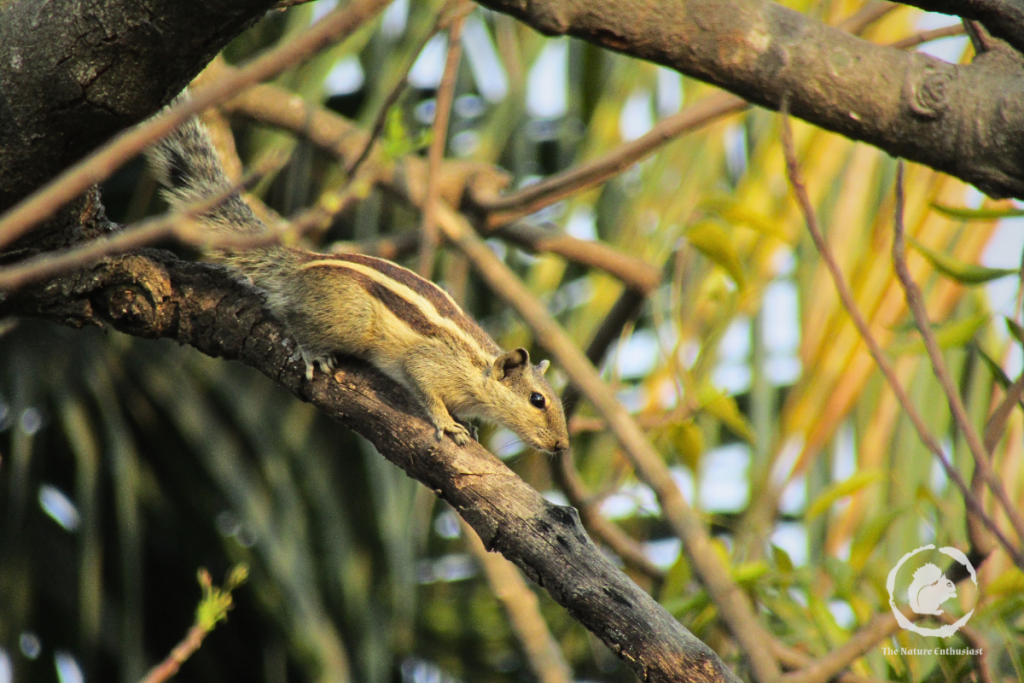
Stashing away precious nuts come with danger – they get stolen! Stolen nuts are a real problem in the squirrel community. But squirrels have found some ingenious techniques to deal with it.
Squirrels are busy hardworking creatures – always running across fields, scrambling up trees, tightrope walking on narrow tree branches, flying across structures and collecting nuts. Their illustrious career appears to be built around one sole purpose, collecting enough nuts so that they never run out of them. They survive the entire winter on their autumn collection, their offspring are sustained on them and the inheritor of a large midden (hoard of acorns or pinecones) are probably the equivalent of the wealthy class of the human society. And just like that, they spend a large chunk of their relatively short lives finding food, eating some of it and hoarding the larger part. So deep was their dedication that even evolution felt compelled to repurpose their adaptations for them to suit their day job better.
However, just storing nuts is not enough. There are thieves among them who steal nuts from other squirrels. But squirrels stealing nuts – it’s nothing new though!
Storing for the winter
Squirrels are majorly herbivorous consuming nuts, seeds and tree buds. But depending on plant produce for food requires a deep understanding of nature’s pulse – synchronizing one’s activities to better match it because only in riding this pulse lies the secret to a successful life. Squirrels, being the intelligent creatures that they are, have long aced this game. They forage on nuts, seeds and greens when the yield in high, harvest the excess and carefully store them for that time of the year when food will be scarce – winter. They have invented numerous ingenious techniques to extend the life of their hoards keeping stored foods intact for long periods of time – like the American red squirrels who keep their acorns in middens away from soil or the flying squirrels of China that make grooves on the shells of oak nuts and tucks the whole nut in Y-shaped forks of thin tree branches or the naughty eastern grey squirrels who altogether discard the future germinating structures of an acorn before storing them.
Hoarding strategies employed by squirrels can be classified into two broad categories – larder hoarding and scatter hoarding. In larder hoarding one single cache is made out of all collected food items and the midden is defended by the hoarder. Whereas, in scatter hoarding multiple cache sites are made each housing a single nut or a very few of them and since such a huge number of caches are physically impossible to defend, squirrels rely mostly on cognition for cache retrieval and cryptic placement as defence against cache pilfering. A third category that makes use of a combination of the above two strategies is called mixed hoarding. Chipmunks use a mixed hoarding strategy as having cheek pouches enables them to carry a large number of seeds which can be deposited all at once in a single cache or distributed across multiple caches in a single trip.
(How do squirrels locate cached food? Learn about the techniques they use to find hidden nuts in this article!)
But hoarding enough for the winter is not a foolproof strategy – they must be protected from cache pilferers. The problem is more pronounced in scatter hoarders as caches are not physically defended and hence more prone to getting stolen.
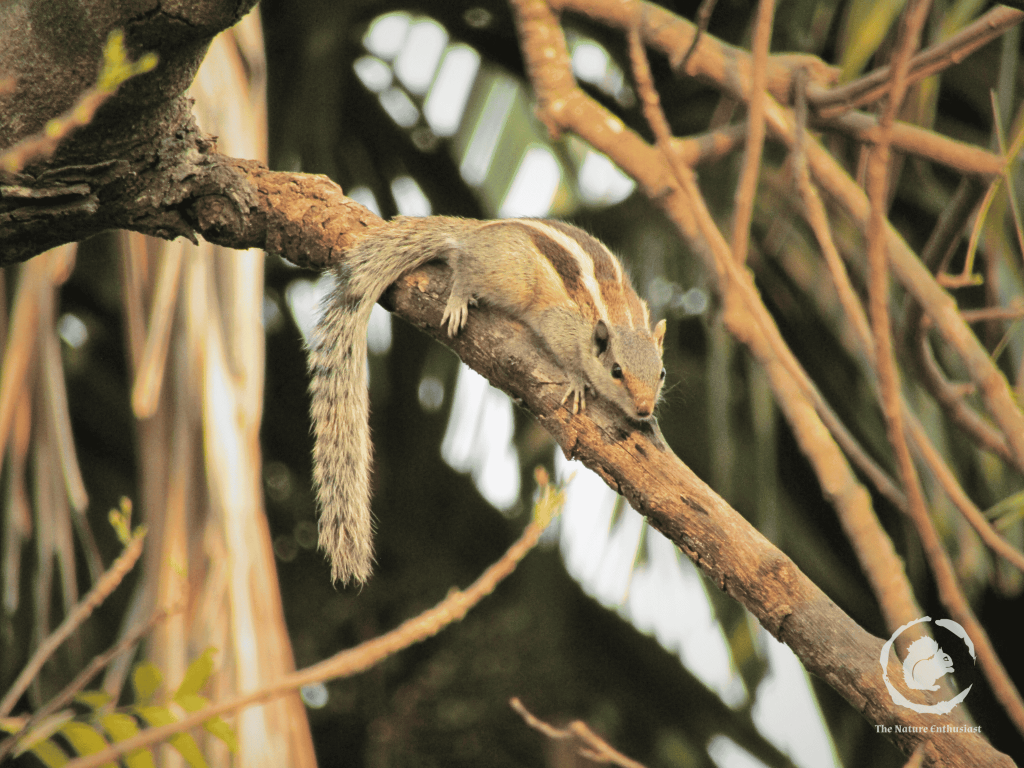
Cache pilfering – a steal deal for one and nuisance for the other
Stashing away precious seeds without being present to guard them can come with added dangers – they could get stolen! Another squirrel could be hiding in a bush nearby watching or splooting on a tree branch overhead when it happens to see by accident a fellow squirrel dig the ground and drop a nice big hazelnut into the hole and carefully cover it with soil so that looking at the spot no one can suspect a hazelnut under those grains of dirt, blissfully unaware that he is being watched. It’s a steal deal for the cache thief getting a nut for free! As overly dramatic as it may sound, it does happen.
Cache pilferage is a real problem in the squirrel community. So how does one squirrel deal with this problem?
There are several strategies that squirrels employ to deal with cache loss to pilferers. Let us discuss them one by one.
Multiple caching
Observed in grey squirrels, multiple caching involves the digging of several holes in the ground but the food item in dropped in only one hole, most often the last site dug and all the rest sites are left uncovered. The strategy is interpreted to be a means to confuse conspecific and heterospecific observers nearby about the actual location of the food item. Multiple caching could also be the outcome of the squirrel’s attempt at finding the most suitable site for caching in which case all the other sites are abandoned because they were simply deemed unsuitable. However, one observation shows that grey squirrels did more multiple caching when other squirrels were nearby compared to when they were at a distance. Nonetheless, multiple caching could be a viable strategy to tackle pilfering as it would cost the pilferer several attempts before arriving at the original caching site or even finding it at all.
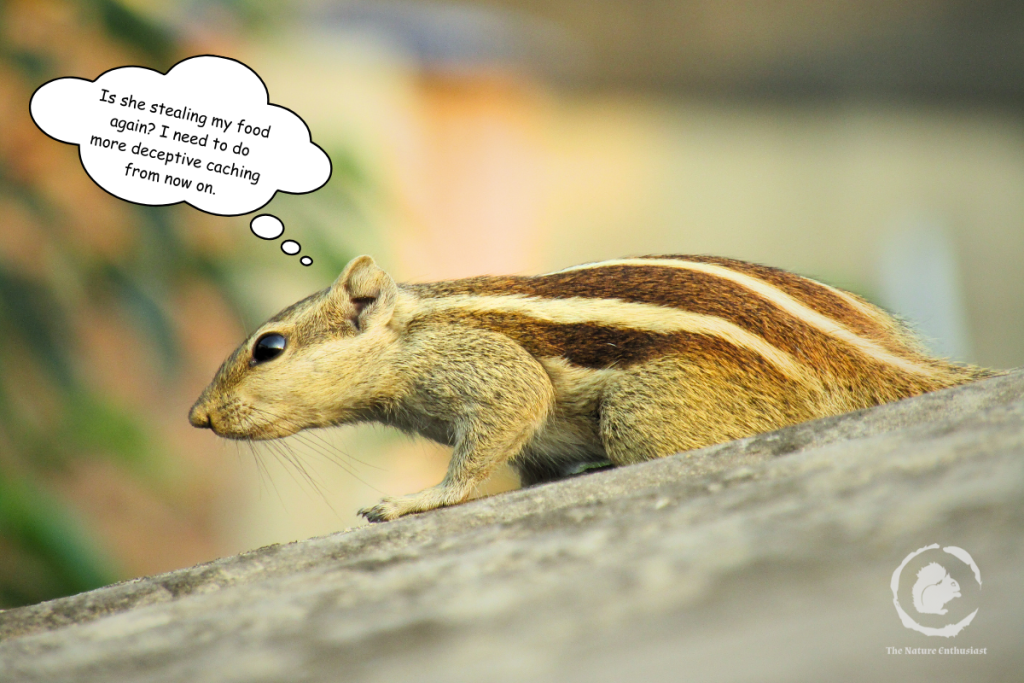
Deceptive caching
This one is a very interesting behaviour and evidence of its presence in squirrels was first observed in a paper published in 2007. Nut caching in squirrels involves a series of specific body movements. First the ground is dug up with the front paws, then the food item usually a nut carried by mouth is dropped into the hole, next the nut in thrust deeper into the soil by applying sufficient force with the entire body. When the nut is pushed to a desirable depth into the ground the squirrel again uses its front paws to pull in loose soil to cover the nut after which it thumps over the spot with both paws alternating them in a patting motion to level off the ground. Often debris and other nearby vegetation are pulled in to blend in the site with the surrounding landscape.
Deceptive caching involves all the above sequence of activities excluding just the moment when the nut is dropped. So, in deceptive caching the food item is retained but the rest of the routine is performed to give the impression of a cache being made. Sometimes squirrels cover excavated grounds without the food item in it while at other times they pretend to cover unexcavated ground right after making a cache elsewhere. Observer squirrels have been seen to arrive at the spot where the deceptive cache was made and make attempts to excavate the ground and retrieve the nut after the squirrel making the cache has left the spot. Squirrels make more deceptive caches when other squirrels are in the vicinity so this behaviour is interpreted as an active act of deception aimed at preventing cache pilfering. Squirrels make more deceptive caches in the autumn months when the need to store food items increases and limited resources are available while energy demands are high as ever. All the above observations show that deceptive caching is indeed a viable tactic that protects the performer against cache pilfering.
In his study Steele employed human pilferers who would search the caches of grey squirrels under study. The human pilferers mimicked the activity of actual squirrel pilferers like observing other squirrels carry nuts, dig out soil and finally cache the food item then the pilferer had to use those behavioral indicators to find the cache site where the food item was actually cached. Since, humans and squirrels have similar visual acuity and human pilferers had no previous knowledge about the experiment, the use of human pilferers in those experiments was assumed to make no significant difference in the results. However, the funny part of the experiment was that when squirrels used deceptive caching and multiple caching it was both difficult and time consuming for human pilferers to find the right caches that actually had something in them to recover. When the squirrels under study realized that their acorns were disappearing from their caches they made more deceptive caches, often caching behind obstacles and out of sight of human observers or choosing to consume nuts that very instant instead of storing them for the future.
Reciprocal pilfering
If the proverb ‘to pay one back in the same coin’ had a fitting scenario it would be in the situation of reciprocal pilfering in squirrels. Reciprocal pilfering is a situation in which to offset the effect of cache loss to pilferers the squirrel whose cache was pilfered gets involved in pilfering the caches of other squirrels. When all squirrels living in a habitat steal from each other to some extent, there is not much net loss or gain in individual cache size in that population.
In a 2005 study, Gerhardt found that reciprocal pilfering occurred among North American red squirrels that are larder hoarders. Of all the cones the squirrels ate 26% were stolen from others and as for the cones in their own larder, 25% was lost to pilfering by others.
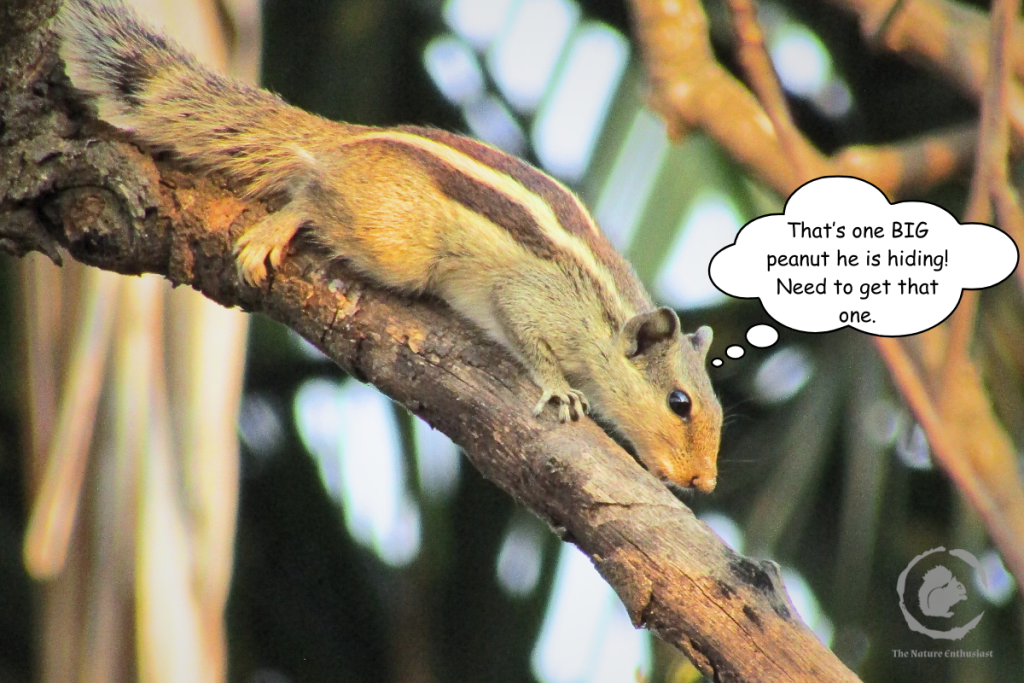
Caching in seclusion and cryptic cache placement
Western grey squirrels were seen to totally avoid caching when in the presence of members of its own species. They store food only when alone, after displacing others or when in the presence of squirrels of other non-caching species like the California ground squirrels with whom they share the same habitat.
Researchers found a direct relation between the level of concealment of a food cache and the length of time it stayed in its original location, hence proving that hiding a cache has benefits for the food hoarder by preventing discovery by pilferers.
Caching in open ground
Squirrels are known to use their spatial memory for recovering cached foods. But a pilferer does not have the same information advantage about a cache site as the squirrel who actually made the cache. Sometimes the pilfering squirrel observe the caching squirrel then reach the cache site and randomly search the area or they may simply stumble upon a cache by following olfactory cues. Squirrels thus make use of the information advantage that they have about the location and content of a cache they made to challenge the pilferer into a daring game, that is, obtain food while facing the threat of predation.
Squirrels cache nuts in open grounds away from the safe cover of the canopy. But this open area is the playing ground of predators lurking overhead in the open sky or hiding in the grass. The squirrel who made the cache knows the exact location so it can make use of speed to retrieve the cache but for the pilferer who has not much knowledge of the cache location, time is precious. More time spent in the open translates to more exposure to the risk of predation.
Squirrels also spend more time on hiding nuts when caching in the open carefully selecting the location and covering the food meticulously thus making it difficult and time consuming for the pilferer to retrieve the contents of the cache and time is a luxury a pilferer cannot afford under the open sky.
Caching with back to observers
Eastern grey squirrels try to evade the attentive gaze of a con-specific while caching by turning their back to other squirrels.
Spacing out caches
Scatter hoarding squirrels try to avoid the risk of cache pilfering by spacing their caches when other squirrels are present around. Fox squirrels carry nuts with higher food value away from the original food source. They often space out the caches of their favourite food items.
One study found after analyzing the DNA samples of squirrels for degree of relatedness that squirrels cache closer to relatives. Benefits of genetic relatedness compensates for the cost endured after losing caches to pilfering in such situations if pilfering does occur.
Another enemy overhead
Keeping watch on just squirrel nut thieves isn’t enough. There’s another enemy to worry about and this one’s more troublesome for it watches from above. Some birds are known to watch squirrels cache nuts, memorize the location then find a suitable opportunity to sneak in and steal the nut. In 2024, researchers studied the bitter-sweet relationship between corvids and red squirrels in an urban park in Poland. They found that corvids stole almost a third of all nuts offered to red squirrels by humans. They preferred to stay close to those squirrels who were caching nuts compared to those that were not. Sometimes squirrels and corvids engage in nasty squabbles – with corvids stalking squirrels and squirrels trying to chase away corvids – a scene straight out of Tom and Jerry!
Scatter hoarding helps with defending caches against such feathery thieves as birds cannot locate buried food by sniffing.
Conclusion
Even after so many measures to avoid getting food stolen cache pilfering does occur. But some preventive moves rather than no action is always better. Why cache pilfering occurs needs no explanation. Well, who dislikes a free treat? But why the practice is maintained in the population demands an elaborate explanation. If the benefits outweighed the cost by a tremendous amount then cache pilfering would have been more rampant but only 30% of all stored food gets stolen each day. But losing some stored food does have a cost otherwise squirrels would not adopt all those measures to avoid pilferage. Totally wiping out stealing would be an expensive undertaking. Squirrels have thus accepted to live with it by tolerating a certain level of cache pilfering for life is better without fights. Reciprocating stealing with stealing seemed to be a good option.
Stealing is viewed as bad in the human society. We don’t know how they view it in squirrel society but to come back and see a stored nut had just vanished cannot be a good experience for anyone.
It can be hard to get rid of bad habits. But bad habits don’t stay bad when everyone does it for then it becomes just another habit. Who knows, maybe stealing nuts evolved as just another habit for squirrels.