
If the Wood Wide Web is the internet of the forest, then mycoheterotrophic plants are the hackers in the network. Scientists often call them mycorrhizal cheaters as they hijack the underground root fungal network and freely tap out sugar solutions en route through the mycelium without paying for it.
Mycoheterotrophs are non-green and hence they cannot photosynthesize their own food. They thus have to depend on their photosynthesizing brothers for the sugars. And they do it by covertly joining the Wood Wide Web underground fungal network.
Mycoheterotrophs allow mycorrhizal fungi to colonize their roots. Their mycorrhizae connect to the common mycorrhizal network running between neighbouring plants. By silently becoming part of the network they partake from the uninterrupted sugar supply the fungal partner receives from photosynthetic plants in return for their services. In other words, mycoheterotrophic plants cheat and steal.
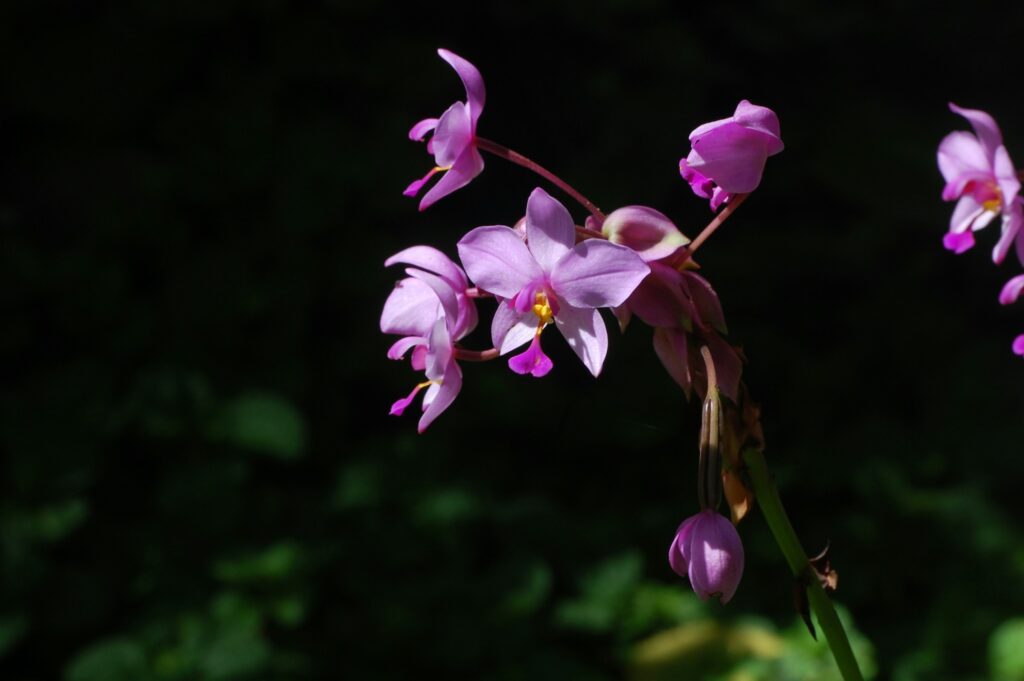
Many beautiful orchids fall in the category of mycoheterotrophs. (Don’t go for looks, they say!) Orchids are known epiphytes and when they depend on a fungal partner for their nutrition they are called mycoheterotrophs.
Mycoheterotrophs: The exception rather than the rule
Relationship between plant roots and mycorrhizal fungi tend to be built on mutualistic principles – a sort of give and take policy between the partners. The fungal partner provides an extensive underground network that helps take up growth-limiting nutrients and water from the soil for the plant. Whereas the plant provides photosynthetically fixed carbon to the fungal partner in return. Such is the general norm for a mutual partnership.
Mycoheterotrophs, on the other hand deviates from this set path. They are the opportunists in the system. They harbour mycorrhizal fungi in their roots which connect to the common mycorrhizal network underground and become a part of it. But being non-photosynthesizing by nature mycoheterotrophs cannot provide any carbon containing photosynthate to their fungal partner. So, while sugars from neighbouring photosynthesizing plants are in transit for provision to the common fungal mycelium, they are picked up by the mycoheterotrophic plants from their own mycorrhizae and diverted for their own use.
The partnership between mycoheterotrophic plant roots and mycorrhizal fungi is not mutual. They are the exception rather than the rule in the Wood Wide Web ecosystem.
Mycoheterotrophy vary by degree and phase
Approximately 580 species of plants are fully mycoheterotropic. They depend on their mycorrhizal partners for all of their carbon supply. They do not have any cholorophyll and include dicots, monocots, a gymnosperm and a bryophyte.
Then there is another category that are initially mycoheterotrophic where they depend on carbon from mycorrhizae for the initial stages of their germination and growth. In later stages of their lives, they turn photosynthetic hence making their own carbon from CO2. Almost all orchids fall in this category.
Some photosynthetic green plants depend partially on mycorrhizal carbon in their adult life stages. They are called partial mycoheterotrophs or mixotrophs supplementing their own photosynthesized carbon with photosynthates from their more efficient neighbours.
Mycoheterotrophs evolved from Autotrophs
Mycoheterotrophs evolved from autotrophs via different stages. First to evolve were initial mycoheterotrophs followed by partial mycoheterotrophs through to full mycoheterotrophs.
Because mycoheterotrophy represent a deviation from mutualism it is described as an example of ‘mutualism breakdown’. Mycoheterotrophy is said to have evolved at least 40 times across ectomycorrhizal, arbuscullar mycorrhizal and orchid mycorrhizal symbioses.
Mycoheterotrophs: A living testament to the existence of Wood Wide Web
The existence of mycoheterotrophs is a living proof of the existence of extensive common mycorrhizal network running underneath forest floors. It is also indirect evidence of the vast amounts of carbon transferred via the Wood Wide Web network and that they are widespread.
Mycoheterotrophs take several years to develop after germination till fruiting. Some mycoheterotrophic fern gametophytes even live for many years which stand testimony to the fact that connections between fungal mycorrhizae and neighbouring plant roots are maintained or re-established over a long span of time.