
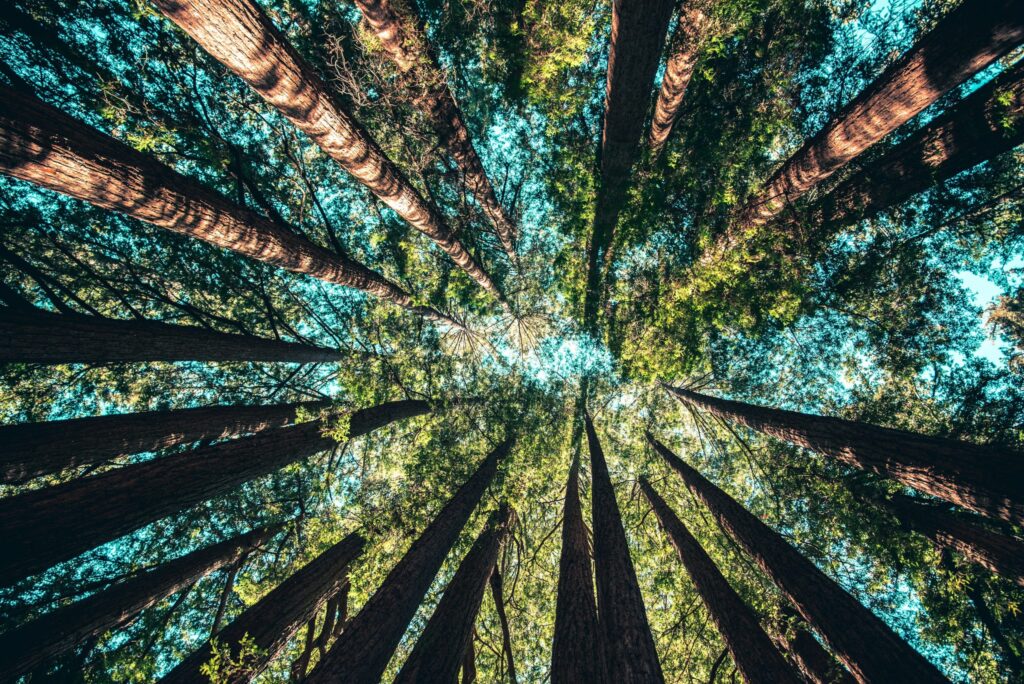
The Wood Wide Web, an underground mycorrhizal network that connects trees together in a forest is known to many. But how true is the Wood Wide Web hypothesis?
Many mushrooms you see sprouting at the base of trees or on a damp patch of forest floor are not random. If you dig deeper you shall find they are just the tip, the visible part of something far more larger and complex, spread out deep below the ground under our feet. The mushroom is only the reproductive organ of the fungi that colonizes plant roots called mycorrhiza. They surface for a narrow window of time with the sole purpose of reproductive propagation. The real deal is hidden below the ground.
Underground roots of most land plants are colonized by mycorrhizal fungi that form a symbiotic association with the host plant. The host provides the fungi with food synthesized from photosynthesis in its chlorophyll containing leaves and other green structures. While the fine capillary like fungal mycelial network help the plant absorb water and critical nutrients from soil that the root alone couldn’t have taken up. Sometimes the same mycorrhizal fungal body colonize roots of different plants at the same time, hence, connecting them to one another. In an old growth forest where the ecosystem has been undisturbed for a long time mycorrhizal fungal networks spread far and wide connecting the whole forest through a common hyphal network. This way substances can be exchanged with mycorrhizal fungi of neighbouring plants or as far as the common network reaches.
This mycorrhizal network between trees has been dearly called the Wood Wide Web synonymous with the World Wide Web, the abbreviation “www” generally found at the start of a web address.
The concept of the Wood Wide Web has garnered excessive media attention and captured the imagination of artists, writers and common folks alike. The idea of a forest ecosystem functioning as a single entity or a “super-organism” has been one of the primary fuels behind the making of the blockbuster movie Avatar (2009), that still holds the record as the highest grossing film in the history of cinema.
Mycorrhizal fungi are essential for the proper functioning of the forest ecosystem and maintenance of its health. However, the various roles played by mycorrhizal fungi has been blown out of proportion in the past two decades or so. They have been assigned skills and activities they neither possess nor perform. Or at least the ones not known till now.
As far as the fame of the Wood Wide Web is concerned, we are basically staring at a scientific void with near zero research evidence to back the big claims made regarding their exceptional roles.
Let’s look at the reality of it all – the phenomenon, the myth and the legend surrounding the roles played by the great Wood Wide Web fungal networks spread underneath the ground.
Wood Wide Web – The Phenomenon
Mycorrhizae are actually symbiotic association between the plant root and fungi. They can be of two types – endomycorrhizae and ectomycorrhizae. The first one as the name suggests is invasive and penetrates the root cell walls hence entering the cell body. The second one forms a fine mesh-like structure on the plant roots without invading the cells. But sometimes they send their hyphae between the intercellular spaces of the plant root cells. This ectomycorrhizae is the main type of fungi responsible for colonizing many tree roots, connecting them together in turn via a subterranean fungal network called the Common Mycelial Network (CMN). Endomycorrhizae also contributes to the CMN.
It is through the Common Mycelial Network (CMN) that trees connect physiologically. CMNs can be either inclusive or exclusive. When inclusive many different plant species are brough under one network. Exclusive connections occur when specific types of mycorrhizae colonize only particular species of plants hence connecting only the same plant species into a singular network. CMNs also form mycelial cords formed by parallel hyphal strands that sometimes extend to several meters.
Evidence exists in support of net carbon transfer between trees via mycorrhizal root networks. Carbon in the form of photosynthates is transported from nutrient-rich source trees to nutrient-deficient sink trees via the subterranean Common Mycelial Network. During seasonal and ecological changes when photosynthetic rates vary between different tree species or individuals, nutrient resources are shared in a manner that benefits nutrient-deficient members within the common network.
Nitrogen-fixing leguminous plants have been shown to distribute excess nitrogen to nitrogen-deficient non-leguminous plants using the CMN as a medium.
Evidence for transfer of allelochemicals and weedicides via the CMN to neighbouring plants have also been found.
Similarly, warning signals when a plant is under herbivore attack, has been communicated to neighbouring plants via the mycorrhizal network in a form still under investigation. But it has been observed that on receiving the signal plants start producing volatile organic compounds for repelling insect pests.
Wood Wide Web – The Myth
Plants were considered anything but altruistic. Individual plants were always known to compete with one another for resources like water, soil nutrients, space and sunlight. However, with the advent of the Wood Wide Web concept a long train of emotionally stimulating theories emerged which were nothing more than just mere speculations without much scientific backing. They captured the imaginations of scientists and laymen alike.
Articles talked of trees chatting with one another using electrical signals transmitted through fungal hyphae acting like land line cables. Claims were made that the subterranean mycorrhizal network is utilized to send warning signals (drought, pest attack, stress) to other trees connected to the network, much like a community broadcasting system or social media. Some older trees with more intensive mycorrhizal networks were said to take on the role of “Mother Trees” nurturing the younger ones with water and nutrition aiding their growth. Healthy trees were said to consciously take care of weaker trees by providing them help in the form of nutrition and necessary chemical substances.
Sadly most of the above claims were not based on extensive scientific research evidence. Studies in favour of the “tree talk” claims were inflated by the media to extraordinary sizes. Whereas much of the other researches that didn’t find enough support to solidify the claims made about the Wood Wide Web were sidelined, often excised with almost surgical precision from the popular literature of the times. While some scientific details were lost in translation when narrated in the layman’s tongue.
The 2009 science fiction movie Avatar helped spread the idea like wildfire. Dull scientific facts were buried under the glamour of fiction. Thus emerged the myth of the Wood Wide Web.

Wood Wide Web – The Legend
The Wood Wide Web is nonetheless a legendary figure with numerous praises that narrates the good deed it does for the plant community and the ecosystem as a whole.
The Wood Wide Web or Common Mycelial Network (CMN) is extremely essential for plant survival and drought resistance. Without mycorrhizae plants cannot absorb many minerals and nutrients from the soil that exist in insoluble forms. Mycorrhizal fungi has enzymes to covert such nutrients into soluble forms that can be easily absorbed by plant roots. A vast percentage of soil water remains untapped without the presence of mycorrhizal fungi in plant roots.
Many plants that cannot photosynthesize at rates similar to autotrophs are largely dependent on Common Mycelial Network for their nutrition. They are called mycoheterotrophs or partial-mycoheterotrophs like the orchids. These plants mostly exploit the Common Mycelial Network to derive nutrients from photosynthesizing plants without contributing anything in return. In other terms, they steal and are thus parasites.
Mother trees may not be real per se, but the Common Mycelial Network (CMN) help with the balanced distribution of resources like food and minerals. Much like movement from high potential to a lower potential point, resources flow from areas where resources are abundant to regions in need. The process promotes cooperation among plant individuals in a forest ecosystem and efficient use of natural resources helping in the survival of the forest as a whole.
The Wood Wide Web may not be the equivalent of the internet but information in the form of chemical signals are transmitted through the underground mycelial network. The message obviously would not be “Under pest attack! Take action!” but communications between plants via mycorrhizal networks have shown to prepare plants to respond faster to stress.
Many aspects of the Common Mycelial Network (CMN) or the Wood Wide Web are under investigation and it is for the future to reveal what more legends are born from novel scientific findings.