
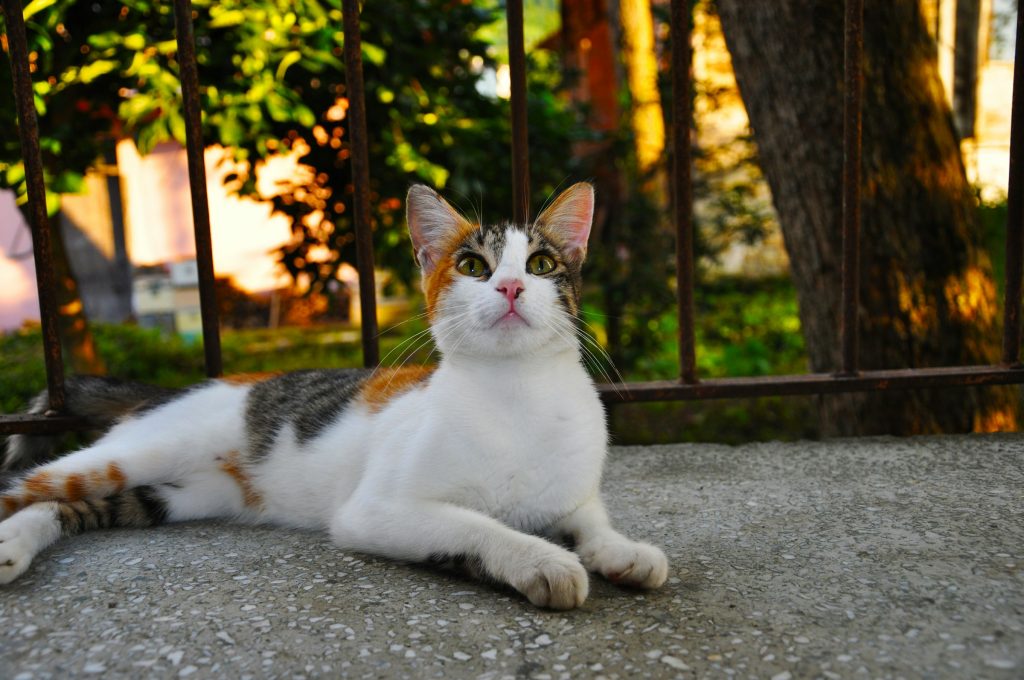
Sporting a mosaic blend of three fur colours is an essentially feminine feline affair. But very rarely male cats also take part in the calico and tortoiseshell coat pattern trend. Want to know why? Then keep reading!
We all love cats. Even if some of us do claim that they don’t find cats worthy of all the attention they receive worldwide, I am pretty much sure that even they find it difficult to skip those pretty cat reels loaded with cuteness flooding social media.
Like any other kid who wanted a pet to play with, I wanted a cat. But the biggest problem was deciding on the colour. If you can transport back to your childhood, you would see how picky you once were with colours. I told my parents that I wanted a white, an orange, a grey and a black cat – that makes them four in total. Oh, parents! When have they ever listened to us? Very rarely. I doubt they ever realised that deep down I felt this very strong urge to turn our house into a cat sanctuary and given the opportunity I might still do so. A year later however, the family living next to us got a cat – a female that was a patch work of black, orange and white fur – for their kid who just happened to be my playmate. I had the wholesome opportunity to play with Chuchu. Yes, that was her name because she only responded when we called her “choo-choo”. Later on, it came to my understanding that most cats respond to that sound, not just our Chuchu!
Chuchu was a calico cat and a female like any other calico cat. Yes, 99.9% calicos are female. But, why?
Why almost all calico cats are female?
Calico is not any special breed of cat but just another normal domestic cat (Felis catus). However, they are different from other cats in having a tricolour coat made of white, black and orange fur. The term ‘calico’ comes from the city Calicut, located in the state of Kerala in India. Calicut (Kozhikkode in Malayalam, native language of Kerala) specialised in making the calico fabric, a plain-woven cotton textile on which designs used to be printed in different colours. Since, the background coat colour of the calico cat is white with large conspicuous patches of black and orange fur, it is named so after the fabric which has a similar appearance.
There is another category which is similar to the calico – the tortoiseshell. In the tortoiseshell cat the coat background is black with either small or large patches of orange fur. White patches can be present in small areas or totally absent. The phenomenon that gives rise to the tortoiseshell pattern is the same that imparts the calico cat its mosaic coat.
Calico and tortoiseshell cats are mostly female because the orange coat colour is linked to the X-chromosome. The nature of the allele present on the X-chromosome determines whether eumelanin, which is the pigment responsible for the black and brown colour, or pheomelanin, the pigment for red, orange and yellow colour, will be synthesised. Since, females have two X-chromosome, one of the chromosomes is inactivated in a phenomenon called dosage compensation. This occurs at the 64-cell stage of the embryo and the decision as to which of the two X-chromosome will be inactivated is random. After the random inactivation the cells continue to divide normally. The progeny cells of each of the 64 cells that went through the random inactivation process, maintains the decision that was taken at the 64-cell embryo stage through all the divisions that follow, inactivating the same X-chromosome after each division.
Now, if the female with her two X for sex chromosomes, is heterozygous for the allele that controls coat colour phenotype located on the X chromosome, the random X inactivation will give rise to a mosaic of cells with different gene expressions patterns. As the progenies of the cells tends to stay close together, this creates a patch of cells with the same gene expressing from the same active X-chromosome surrounded by other such patches of cells with the other active X-chromosome. This is the reason why all females are a patchwork of cells with alternating X-chromosome expressing alleles.
For males the situation is different because males have only one X-chromosome! So, there is no question of X-inactivation. Male calico and tortoiseshell cats do occur but they are very rare and almost all of them are sterile. The male calico cat is just a cat version of the more popular human Klinefelter syndrome, characterised by the occurrence of an extra X chromosome due to a non-disjunction event at the time of meiosis (the cell division that occurs in gametes). Random X-inactivation or dosage compensation gives rise to the same calico coat pattern in male cats with an extra X chromosome (39, XXY).
Genes behind coat colour variation in cats and their dynamics
There are many genes that influence coat colour variation in cats. However, we will only discuss those responsible for the black, orange and white coat colours here.
White coat colour
Regions of white fur on the body generally mean that melanocytes (pigment producing cells of the skin) are absent in those regions. It happens because melanoblasts, which are actually melanocyte precursor cells, fail to migrate to those regions during embryonic development from the neural crest cells. This also explains the close link observed between the presence of white fur and blue eyes (due to absence of pigments in the iris) along with deafness in cats. Thanks to their common origin from the neural crest cells, the same abnormality is responsible for the failed migration of melanoblasts and malformation of craniofacial organs like the ear.
The gene responsible for white coat colour in cats is represented by W with four allelic forms – WT for total depigmentation, Wh for high degree of white spotting, Wl for low degree of white spotting and w+ for full pigmentation which is also the wild type allele with no white spotting. WT shows dominance (epistasis) over the other alleles for partial white spotting.
The most probable candidate gene for white spotting has been narrowed down to the KIT-PDGFRA region on chromosome B1 in cats. The Kit gene encodes a receptor tyrosine kinase that plays an important role in the migration and survival of melanocytes during the development process. Mutations in the gene therefore interferes in pigment cell migration and hence the absence of colour in certain areas of the body.
Complete albinism or more appropriately oculocutaneous albinism, is the cause for complete absence of pigment resulting in full white coat and red eyes with vision problems. The gene involved is Tyrosinase (Tyr) mapped to the C locus. Tyrosinase controls the initial rate limiting step in both eumelanin and pheomelanin synthesis. It is the same gene that is associated with temperature mediated melanin production found in the Siamese and Burmese cat. A null mutation in both copies of the Tyr gene gives rise to complete albinism (c/c) due to loss of function of TYR protein. It is a recessive trait and occurs very rarely in cats.
Orange coat colour
Orange fur colour is due to pheomelanin production. The decision as to whether eumelanin (black pigment) or pheomelanin (orange pigment) shall be produced by the melanocyte is decided by the activity of pigment-type switching genes. Two of the major players are Mc1r (Melanocortin 1 receptor) and Asip (Agouti signaling protein). High levels of MC1R activity results in pheomelanin production thus giving orange coloured hair. Whereas ASIP acts as an antagonist to MC1R and its presence blocks MC1R activity thus resulting in eumelanin production.
If you are wondering about the name ‘agouti’ you probably have guessed it right already! Asip is the gene whose intermittent activity results in eumelanin production between two rounds of pheomelanin synthesis giving rise to the agouti hair pattern – a single black band with yellow bands on either side of it.
Orange colour in cats is determined by a gene located on the X chromosome. The exact gene is still not known (under review) but it is no pigment producing gene. The product of this gene (under review) must have a role in the pheomelanin production pathway with the dominant Orange (O) allele promoting pheomelanin production resulting in the orange coat colour and the recessive o allele blocking pheomelanin production hence keeping the way clear for the expression of other pigment producing genes. The pigment that will be expressed in the absence of orange is determined by genes present at other loci in the organism’s genome.
Since, the Orange locus is present on the X chromosome its expression is sex linked. Heterozygous females with O/o alleles have patches of orange and non-orange colour fur spread over the body due to random X-chromosome inactivation for dosage compensation. When the orange patches occur on a black background it is called a tortoiseshell pattern and when on a white spotting background it gives the calico pattern.
Black coat colour
Black hair colour is imparted by the pigment eumelanin produced in specialised organelles called melanosomes contained within melanocytes, which further distribute the pigment to keratinocytes that form the hair shaft. The gene responsible for black coat colour is Tyrp1 which encodes for the enzyme tyrosinase-related protein 1. TYRP1 plays an important role in the production of eumelanin. The dominant wild type allele is B+ producing a black hair colour. Mutations in the Tyrp1 gene causes dilution of pigment by decreased production of eumelanin. The recessive b and b1 alleles cause dilution of black eumelanin giving the fur chocolate and cinnamon colour respectively. The allele hierarchy is such that darker alleles are dominant over lighter alleles (B+ > b > b1), where the b allele has a partial loss-of-function and b1 allele has a complete loss-of-function of TYRP1.
Another gene controlling for the black colour is the Asip (Agouti signaling protein) whose gene product ASIP acts as an antagonist to the pheomelanin production pathway, switching it to eumelanin production pathway. The dominant allele is the Agouti (A) which intermittently switches on ASIP production giving rise to the agouti pattern. The recessive form is the a allele, which gives a uniform black colour hair in double recessive (aa) individuals.
Dosage compensation and the calico pattern
In mammals, the male is the heterogametic sex with two different types or heterologous sex chromosomes (Felis catus: 38, XY) while the female is the homogametic sex with homologous sex chromosomes (Felis catus: 38, XX). The male Y chromosome is very small in size compared to the X chromosome and has few genes mostly related to sexual development of the masculine phenotype. Having a single copy of X deprives the male of all the gene copies present in the extra X-chromosome possessed by the female. Females therefore could have double the level of gene products the male is able to produce with its single copy of X. To solve this imbalance one of the X chromosomes of the female is inactivated, effectively leaving her with only one active copy of X that makes her equal to her male counterpart.
X-inactivation is controlled by the locus Xic (X inactivation center) which produces a long non-coding RNA called Xist (X-inactive-specific transcript). Xist RNA coats the entire length of the X-chromosome from which it is synthesized, inactivating it by recruiting chromatin modifying complexes. The decision about which X chromosome is to be inactivated is random. In case more than two X chromosomes are present the n-1 rule is followed (n is number of X chromosomes) in which all other than one X chromosome is inactivated.
This process of X chromosome inactivation is called dosage compensation. It is the reason behind the development of calico and tortoiseshell coat pattern in cats.
We already know that it is the Orange locus on the X chromosome that controls for the orange coat colour in cats. As females have two X chromosomes, each of the X can have either the dominant allele O or the recessive allele o. When both the alleles are O, the coat type is exclusively orange while it is non-orange when both alleles are o. But it is the heterozygous females (O/o) that happens to interest us. Due to random X inactivation at an early developmental stage and epigenetic inheritance of the inactivation pattern in progeny cells, clones of cells develop with the same active and inactive alleles. Clones of cells with the active O allele produce orange colour, while clones with the inactivated O and active o produce non-orange coat colour – the colour being determined by genes located on chromosomes other than the sex chromosomes. Hence, a mosaic coat colour pattern develops in these heterozygous females (O/o).
The calico pattern develops when the background coat colour is white due to the presence of the white spotting W allele. If the spotting is high small patches of orange and black fur is observed.
When the background is black, a tortoiseshell pattern is seen. The tortoiseshell pattern develops when a recessive allele is present at the white spotting W locus, thus white patches are either very small or almost absent. The recessive white spotting allele leaves room for other pigments to develop in those cells with inactive O allele. With no gene product to trigger pheomelanin (orange pigment) production in O inactivated cells, eumelanin is produced giving a black coat colour in tortoiseshell cats. While cells with active O allele give patches of orange fur.
Klinefelter syndrome in cats and the curious case of the male calico cat
Sporting a mosaic blend of three fur colours is an essentially feminine feline affair. But very rarely male cats also take part in the calico and tortoiseshell coat pattern trend. Male calico cats have an occurrence rate of about 1 in every 3000 T-C cats (tortoiseshell-calico). That too due to a defect in their genome – a cat version of the Klinefelter syndrome found in humans (47, XXY). A sex chromosome aberration due to the non-disjunction of X chromosomes during meiosis results in the occurrence of an extra copy of X chromosome taking the total cat chromosome count to 39 (XXY) from the normal 38 (XY).
The double shots of X chromosomes in this male cat is tamed down by dosage compensation. Random X chromosome inactivation that gives the heterozygous Orange locus female cat (O/o) its calico coat also lends the heterozygous XXY male cat (O/o) its colourful mosaic coat.
Male calico cats are sterile due to difficulties in normal chromosome distribution during gamete formation. Just like human Klinefelter syndrome subjects, XXY cats also show abnormal development of the male reproductive system along with other health issues including a reduced lifespan.
Conclusion
Having a male calico cat for a pet would appear to be a rare thing to do but it comes with added responsibilities. Male calico cats due to their genetic anomaly is prone to various health risks and thus require special care.
They have impaired cognitive development that often gives rise to behavioral issues. Metabolic problems increases risk of developing body fat and diabetes. Low bone mineral content makes their bones brittle which further accompanied by increased body weight results in joint pain and frequent bone fracture. Male calico cats also have heart diseases.
If the owner is considering to sign up their calico tomcat for breeding programs they must reconsider. Since male calico cats are sterile one must give up hope for having more calico kittens from him.
Despite all the gloominess revolving around calico tomcats there is good news! Male calico cats can lead normal lives if taken care of in a special manner to deal with these health issues.
Well, if all these information is making your heart ache for the calico tomcat then you must definitely adopt him. Male calico cats need caring cat-moms and cat-dads. Who else will take care of these poor colourful fur babies if not them?