
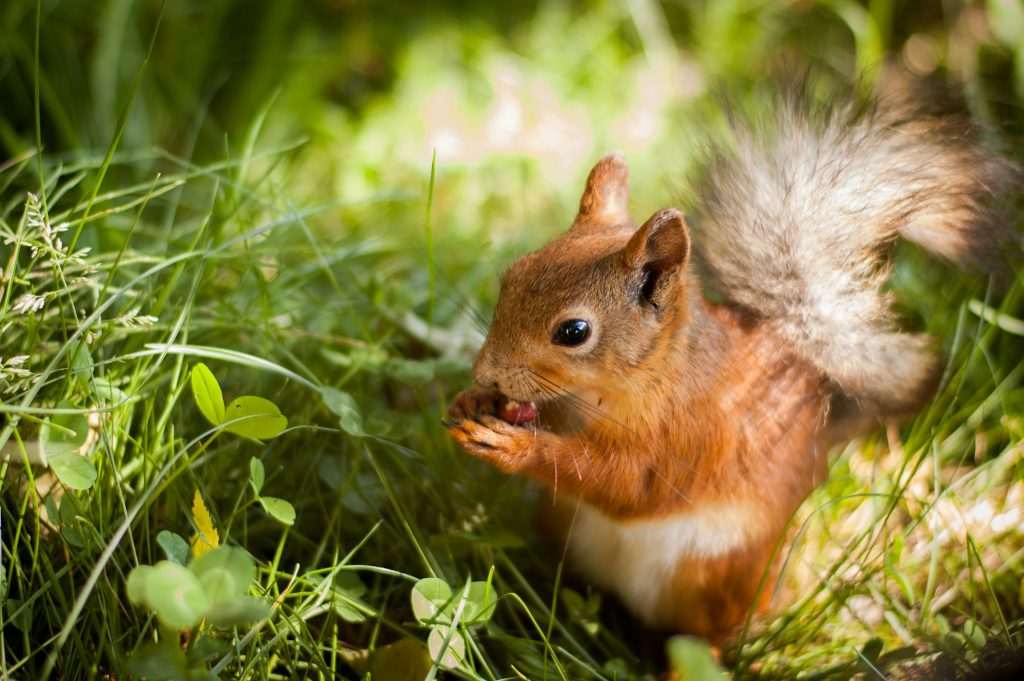
Previously it was assumed that squirrels find hidden nuts by applying their sense of smell. But studies have shown that squirrels remember the locations of the nuts they have hidden by memorizing a spatial map of the area.
Yesterday evening while scrolling through social media I came across a meme (one which I remember having seen before and laughed at before!). The joke went something like this – “I wish I had Google search installed in my house because I can never find the things I want to find when I want to find them”. I laughed again at the joke partly out of habit (the fake laugh one grows when one is fed with endless content throughout the day to the point one forgets to decide when to time the reaction) and partly because I found it relatable (because it happens all the freaking time no matter how well I organize my things).
The other day itself I went berserk because I couldn’t find a very important item (a fountain pen quite special to me, because it was gifted by a dear friend on a memorable day of my life) which I know I had tucked away in some safe corner but couldn’t remember which exact safe corner because there are many safe corners in my house. A day after, my mother couldn’t find her cookbook as I had the whole shelf turned inside out in my attempt to find my precious little item. I understand why she lost her mind. It can be infuriating sometimes when one cannot find the things they thought they had kept securely.
So, naturally it almost hurt me when I set out to imagine the amount of turmoil our little squirrel friends go through when they carefully stash away their delicious nutty treats (mind you, it can be in few thousands each season!), meticulously picking the locations for each one of them only to get frustratingly muddled up every time they set out to retrieve them.
How do they manage to achieve this mammoth task with their squirrel brains? (Disclaimer: It is not directed as an insult to the furry-tail community.) Turns out they are actually pretty good at this hide-and-seek game. Let’s learn a little more about this game of theirs.
Why do squirrels store food?
It is just like asking a person why they keep their money in the bank – because it can be safe and there is a reserve to fall back on when times are needy. The same reasoning applies to the food storing behaviour of squirrels.
Evolving along with the cyclic nature of seasons, plants have adapted to maximize their proliferation by timing the production of their seeds when conditions are favourable for the successful establishment of the seedlings. Squirrels and other animals that depend on these energy packed seeds for nutrition have adapted their behaviour accordingly. When the yield is high squirrels harvest the seeds, storing them for that time of the year when food will be scarce and environmental conditions harsh for survival. Storing food for lean times ensures that the animal thrives through the winter and also gives them an edge over their competitors.
Food storing behaviour is more common in the temperate belt compared to the tropics for the seasonal fluctuations are stronger at higher latitudes hence greater variations in environmental conditions and food availability.
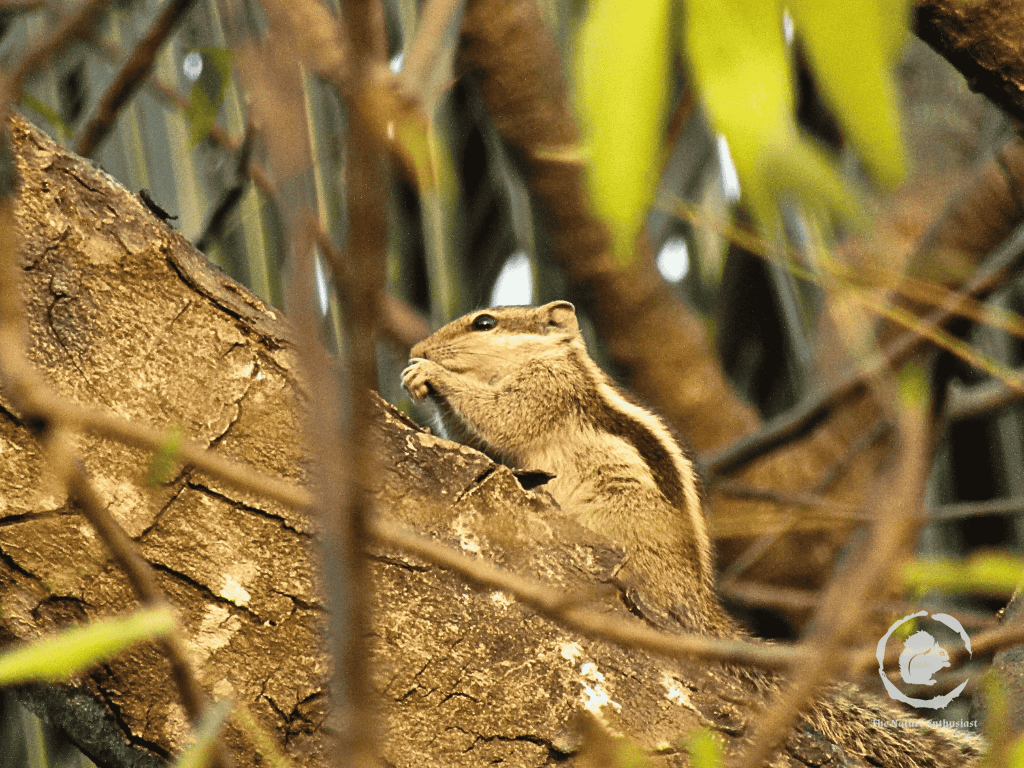
Strategies of seed caching in squirrels
There are two strategies for storing food – first the larder hoarding strategy and second the scatter hoarding strategy.
In the larder hoarding strategy one big heap of food items is made at one spot or few spots within the capacity of the hoarder. This storage, called a midden, is guarded by the hoarder which can be a demanding task as it takes time away from foraging and a social life. Loss of a midden can be very costly to the squirrel as days of hard work may go down the drain all at once.
While in the scatter hoarding strategy one or a few seeds are cached in different locations spread across a wide area by the hoarder. As the number of caches are huge and in numerous locations, they cannot be physically guarded by the hoarder so stored foods are prone to cache pilfering. Taking into account that some of the stored nuts may get stolen by other squirrels, scatter hoarding strategy is employed only when it is difficult for the hoarder to guard the food stores. As only a small portion of the resources are kept in a single cache location loss of one cache to pilfering is not substantial to the hoarder.
(Want to find out why squirrels steal nuts or how they manage to protect their precious nutty treats from getting stolen? Read this story to learn more!)
However, there is one problem with scatter hoarding and that is remembering the exact locations of the cached food items so that it can be recovered when the need arises – and it must be recovered in time as foods stored for long can turn bad over time hence becoming unsuitable for consumption and as for seeds, which are a preferable choice for most food hoarders, if left in the soil for too long can germinate into plants. Scatter hoarders must depend on their cognitive abilities to not only remember where they have cached a food item but when they have cached it.
Use of both larder and scatter hoarding strategies have been observed in squirrels. They use either one or a combination of both strategies depending on the species being observed and the ecology of the population under study.
How do squirrels locate their cached seeds?
Squirrels employ both olfactory cues and spatial memory to locate cached seeds. First, they narrow down on the location using their spatial memory then pinpoint to the exact position of the seed by smelling for it.
Squirrels memorize a spatial map of the area to locate cached nuts
Previously it was assumed that squirrels find their hidden nuts by applying their sense of smell. But studies have shown that squirrels remember the location of each cache by memorizing a spatial map of the area. They make use of nearby landmarks to associate with the position of cache locations. They even frequently refresh their memory by digging out nuts from caches and shifting them to another location or re-caching them in the same place. Such routine checks help them keep a tab on where they have hidden their treats and for how long because if a seed is kept in the ground for too long it will be lost to germination.
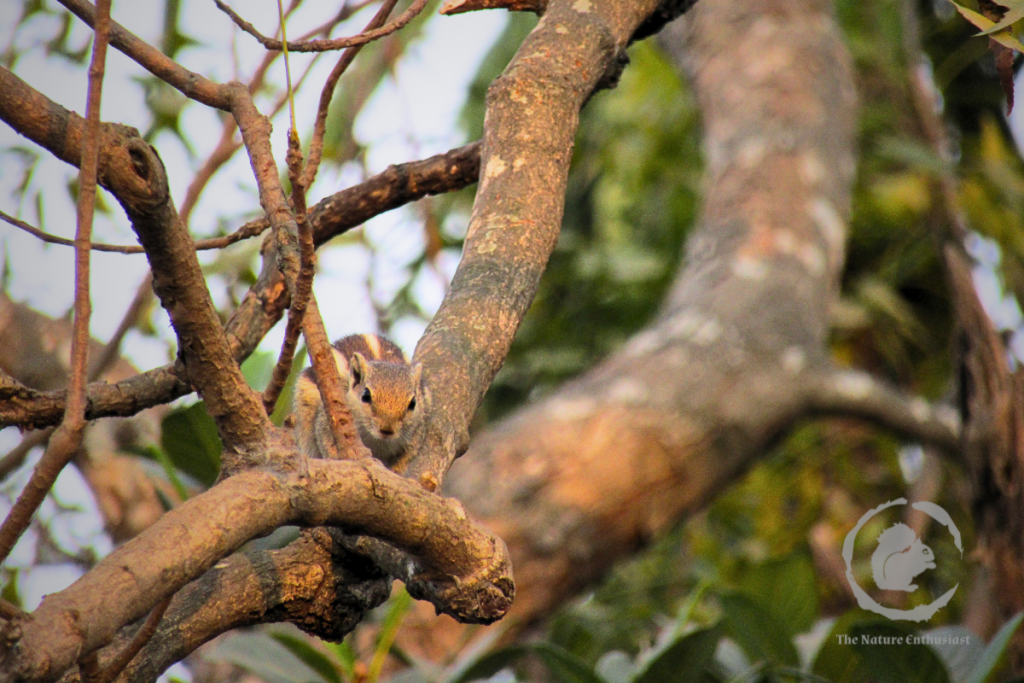
Evidence for use of spatial memory in recovering cached seeds in squirrels was first obtained in a 1990 study done on captive grey squirrels. Jacobs and Liman set out an experiment to find if squirrels showed any preference towards retrieving their own caches or equally retrieved their own caches as well as those of other squirrels in the same area. If the squirrels retrieved more of their own cache it would indicate that they have memorized the location where they had cached the food item and used that memory while recovering that particular cache. If the squirrels under study were using anything other than memory of the cache location like odour cues or just random searching to find the hidden nuts they should be equally likely to retrieve their own cache and that of others. What Jacobs and Liman found was that squirrels retrieved their own caches significantly more than that of other squirrels. Even when caches of other squirrels were nearby squirrels chose to neglect its presence and went ahead to dig its own cache further away. Nothing other than memory of the cache site location could explain such behaviour.
Squirrels make use of visual landmarks to relocate caches
In a 1997 study, MacDonald buried hazelnuts in circular patches of loose soil and put up coloured signs to indicate the presence of food. She explained that grey squirrels quickly learned that food would be present when the signs were up and searched for hazelnuts in the circles with coloured signs during their trips to the patch. She buried two nuts in randomly chosen positions in each circle for four days and allowed the squirrels to learn the position of the nuts. Then on test days she placed ‘decoy’ nuts near the original to see which nuts were taken more. The squirrels retrieved the original nuts with about 86% accuracy and only a very small number of decoy nuts were taken which showed that squirrels remember the position where the original nut was placed. To prove that grey squirrels used short range visual cues to form a cognitive map of the place she moved the sign poles a distance away from their original position. Next, she placed two nuts one in the original position where the squirrels had undergone training with and another at a location that would be the spatially correct position relative to the new pole position. If squirrels were using visual cues to learn nut locations then they should be assuming the new location to be the original due to its relative spatial correctness to the new pole position which is the visual cue in this case. The hunch was proven right – squirrels removed nuts from the new positions which were spatially correct to the new pole positions 88% of the time – a very strong indication that squirrels use visual cues to form spatial memories.
In a more recent study Siberian chipmunks were found to preferentially cache seeds in shallow pits that were visually marked with pine branches, fern leaves or PVC tubes and such landmarks helped in cache recovery.
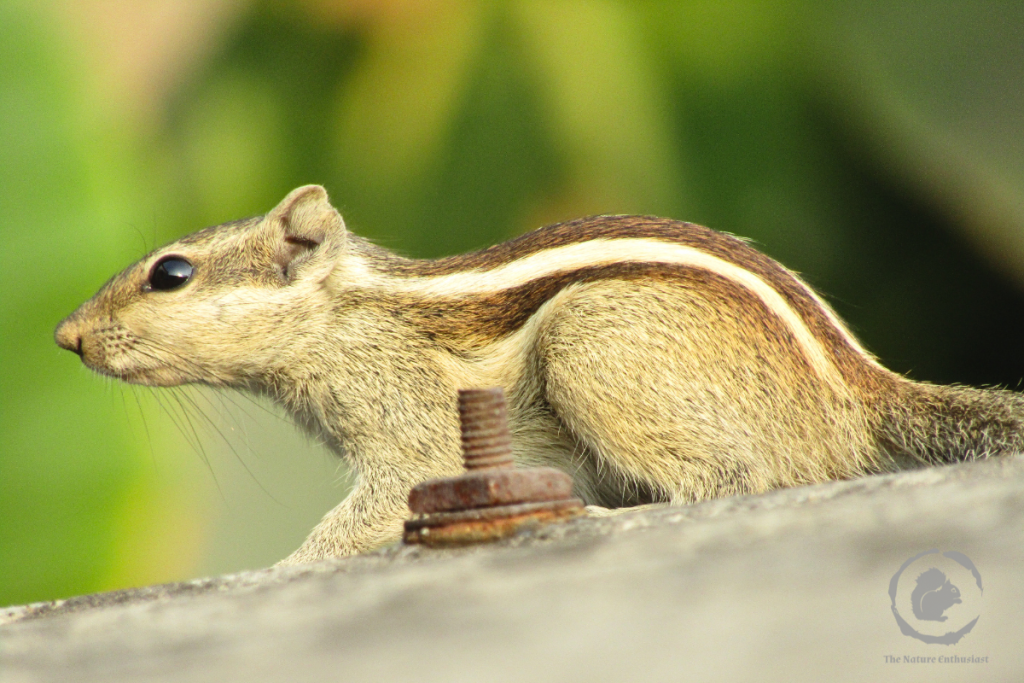
Squirrels use the position and azimuthal angle of the sun to find the way to their cache sites
A 2016 study done on Cape ground squirrels showed clear evidence that squirrels were using the position of the sun as a heading indicator to locate cache sites. As Cape ground squirrels live in groups chances of cache pilfering were high, so caches were made and recovered within a 24-hour period. Researchers provided the squirrels with food and observed the positions where they cached those food items with respect to the position of the sun in the sky. The time of the day and azimuthal angle of the sun to the cache location at the time when the cached food was recovered were noted. Since Cape ground squirrels are central place foragers i.e., they return to the same location or home after foraging it was assumed that they have a ‘familiar area map’ where they memorise familiar landmarks of their home range. The squirrels under study were found to retrieve their cache after approximately 24 hours when the angle of the sun to the cache location was same as the time when the cache was made. When they retrieved cache within 24 hours, the position of the sun was at opposite azimuthal angles to the original time of caching. The squirrels were thus using their internal circadian clock to choose the time of the day when they position themselves at the starting point of the track to the cache location, then using the position of the sun and calibrating the information to the memory from previous day they retrace the path to the cache using familiar landscape features as references. Cape ground squirrels turn out to be expert navigators for it takes some skills to move about precisely in the sparsely vegetated landscape of the Kalahari with no prominent landmarks.
Squirrels make use of mnemonic strategies to facilitate cache recovery
In 2017 researchers found evidence for a mnemonic strategy in scatter-hoarding fox squirrels. Fox squirrels use ‘chunking’ to facilitate memorizing the location and item they are caching. When provided with different species of nuts from a single location wild squirrels chunked seeds of same species in individual caches such that any given cache had only one seed type. Whereas, when different seed varieties were sourced from multiple locations squirrels did not chunk instead the focus shifted towards preventing overlap in cache sites with previously cached areas. Both the strategies followed under different conditions showcase attempts towards reducing stress on memory and eliminate elements that might lead to confusion later on.
What can squirrels teach us about organizing our things?
So, you see squirrels are very intelligent creatures and they do find the nuts they hide. Let’s take a look at the lessons we can learn from squirrels to help us with finding the items we think we have kept safely but always tend to keep forgetting where.
Organize. Organizing our things helps maintain a clean look of the place. We can quickly find an item when objects are sufficiently spaced out and arranged in a pattern which is easy to remember.
Revisit. Revisiting that drawer or just opening that cardboard box which always lie at the top of the shelf collecting dust and taking a minute to browse through the contents helps refresh the memory hence reinforcing the information stored in our brains. Visual memories stay longer and are quicker to retrieve. We tend to want less when we waste less – revisiting old stocks prevents items from wasting away due to continual disuse and may actually help cut down on extra spending.
Reorganize. Reorganizing is important as it helps us keep a tab on our belongings and also helps us sometimes to get rid of unnecessary things hence keeping the place clean. It reshapes our memory and fresh memories are easier to recollect. We utilize resources more efficiently when we reorganize, sorting out perishable goods that need to be used in time and restocking only when necessary.
Give back to nature. Even when squirrels hoard more than they will ever need they do not let their hard work go to waste. Their activities contribute towards the benefit of nature. They help with seed dispersal spreading seeds to locations far from the tree and preventing clumping of saplings under the mother tree where most die due to severe competition. By spreading out the seed from the mother plant squirrels actually help with combating intra-specific competition among the saplings, allowing it to establish itself successfully by obtaining sufficient resources in a less crowded habitat. We can also do the same, for example, redistributing extra items among people we know who might need the item more than we do. Consider reusing or recycling or refurbishing or simply donate – it increases the life of an object. Small steps like this can help cut down on our energy consumption and also generate less waste.