
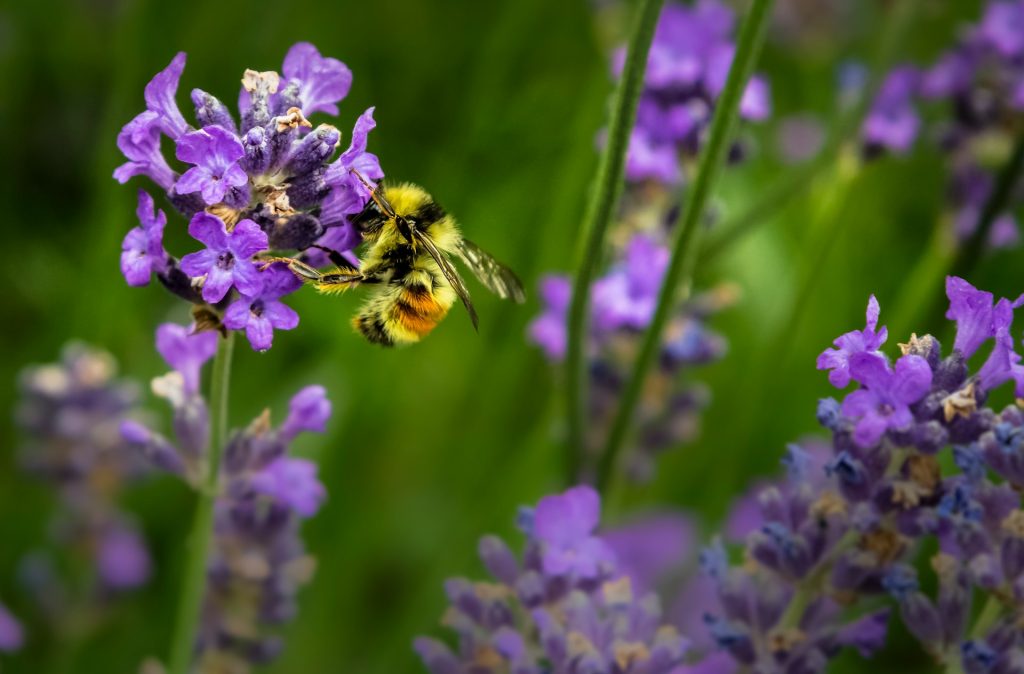
Bees are the most sought-after pollinators. Their food habits, behaviour and co-evolution with flowering plants have made them specially equipped for pollen transfer. Want to know why they are called ‘the beast’ at pollination?
One fine morning a long long time ago, a handful of wasps woke up and realised that their lives were full of violence. A long absence of peace made them feel they were in urgent need of a transformation. Following the enlightenment they promptly decided to abandon the path of cruelty and adopt a more peaceful life. Thus, arose the bees – a forager not a hunter, a herbivore not a carnivore, a welcome visitor not a dreaded predator.
Such sort of an introductory paragraph looks adorable on the first chapter of some children’s book. One cannot deny though that it is an effective strategy of feeding facts laced with some fiction to curious little kids.
Back on a more logical and scientific note, let us talk a little more on the evolutionary history of bees.
It has been inferred from studies of fossil records and other molecular phylogenetic mapping processes that bees actually did arise from apoid wasps sometime around 140 -110 million years ago during the early Cretaceous period. Bees are sturdier and hairier than wasps. More importantly they have undergone a major shift in their diet from their wasp ancestors. They are not flesh feeders anymore but instead they feed on pollen for protein. There are some very few exceptions though where bees are found feeding on carrion, but they do not hunt. They discarded their predatory behaviour when they parted ways with the wasps.
Angiosperms or flowering plants, the significant other in the much talked about plant-pollinator relationship, appears in fossil records around the early Cretaceous period 135 million years ago. But they may have evolved much earlier than thought.
Eudicots which comprise 75% of flowering plants today arose roughly 125 mya. Simultaneously, molecular studies on bee phylogeny suggests that ‘crown group bees’ also appeared around that time frame 125 mya. Discoveries such as this set the stage for scientists to propose theories on co-evolution of flowering plants and their insect pollinators backed by a little more evidence. But there is a possibility that the great diversification of flowering plants, especially eudicots that specialize on bee pollination, took place at about the same time when bees diversified.
Flowering plants have evolved to present flowers with certain set of characteristics to attract pollinators like bees. This phenomenon is named the ‘pollination syndrome’ where plants taxonomically unrelated or distant produce flowers with similar characteristics due to convergent evolution as a result of their dependency on the same or similar pollinator taxa.
It is said that the first angiosperms were pollinated by beetles. Even today the insect pollinator guild comprises of a great variety of beetles, wasps, butterflies, ants, flies, thrips and bees. Wasps, the ancestors and the closest relative of bees, also do help with pollination but it is the bees who does the bulk of the job. Wasps are not as hairy as bees nor do they have any physical adaptations that make them expert pollen collectors. It is the more than 20,000 species strong bees that have evolved as pollination specialists. Flowering plant species cashed in on the evolving expertise of the bees by presenting them with attractively coloured, delicately designed, profusely scented, pollen packed, nectar and oil filled flowers with only one mission – to have their male gametes transported to the female gametes of another flower of another plant of the same species and produce a healthy zygote with a heterozygous genetic profile. This mutual relationship benefits both the flowering plants and the bees and both thrived through time.

Many amazing features, physical and behavioral, enabled bees to be the master of their trade and thus they call for a thorough discussion. These delightful buzzing creatures are already a subject of adoration so a little more information about their business shall make them even more interesting.
Bees forage on pollen, nectar and oil of flowers
It is mostly the female bees that forage on pollen. Pollen is used as a source of protein for their own nutrition and also to feed the larvae. Male bees on the other hand feed specifically on nectar. It is the females that are the major pollen collectors while males only carry those pollen grains that happen to stick to their bodies in the course of their attempts at nectar consumption.
Worker females of eusocial bees like the honeybees actively collect pollen in huge numbers. Flowers produce pollen in abundance as reward for pollination services. Since bees collect and feed on pollen most of the pollen is lost from the pollination chain. With producing extra pollen there is always a chance of some pollen grains landing on stigmas of other flowers despite huge quantities being destined as feed for pollinators.

Flowers provide nectar as a delicious distraction for pollinators (bees here) to have them transfer pollen grains. Sugars in nectar provide energy and is often mixed with pollen grains to form a dough like pellet that can be transported back to the nest for the larvae. Nectar is also carried in the crop (the equivalent of stomach for insects) to be regurgitated into brood cells for storage. Bees can be of two tongue sizes – short-tongued and long-tongued – that dictate the type of flowers they browse for nectar. Short-tongued bees are restricted to shallow flowers while long-tongued bees venture into deep tubular flowers for nectar.
Some flowers produce oil which is collected by bees on their body hairs and carried to the nest to be mixed with pollen for food. Males of orchid bees collect perfumed volatile oils from orchid flowers with special comb-like hairs on their front legs and use them in sexual signaling to attract females to mate with them. In the act of collecting more of this fragrant oil orchid bees end up with sticky pollen sacs on their bodies that later come in contact with female stigmata of the next orchid flowers in the course of their visit. Many neotropical orchid species are exclusively pollinated by male orchid bees.
Bees have hair and baskets to collect pollen
Most bees have hairs on their body and scopae on their hindlegs and underside of abdomen to collect pollen grains. Their body and appendages have hooked brush-like hairs where pollen grains lodge. Bees that carry small pollen grains dry to their nest have densely placed and branched scopal hairs. In the act of collecting more pollen grains from multiple flowers, exchange between flowers occurs involuntarily.

Bees perform grooming movements to collect pollen grains sticking to their body like scraping, combing and dusting. The front appendages are drawn across the mouth and pollen scraped from them for feeding or transferred to the hindlegs into the leg scopa or pollen basket.
Sometimes due to difference in electrostatic charges pollen voluntarily stick to their bodies. When bees leave the nest their body surface potential is relatively less positive compared to when they return from a foraging trip. Flight activity including air friction increases body surface potential towards the positive and most pollen grains being negatively charged stick to the bee’s body.
Female bees of Apidae have pollen baskets or corbiculae on their hindlegs to carry pollen. The pollen basket is the most specialized structure for pollen collection seen in bees. However, none of the collected pollen grains will be of any use in pollination. The bees mix the pollen with nectar, oil or honey to make small pellets with a dough-like consistency which is pressed into the pollen basket for easy transport to the nest.

It is always the loose pollen grains that help in pollination. While drifting from one flower to another collecting nectar, bees unknowingly end up combing pollen from male anthers of one flower and dusting them on the female reproductive parts of the next flower. That’s how pollination occurs – not by intention but by accident!
Most bees are solitary while some are social
When one thinks of bees one imagines swarms of them living in hives dripping with honey. But it is only the honeybees and stingless honeybees that live in colonies and also make honey. There is complete division of labour and social hierarchy within colonies with queen bees laying eggs and worker bees doing rest of the work of colony maintenance while drones having only one job of mating with queens who will establish more colonies elsewhere. They are the highly eusocial bees.
Bumblebees, some sweat bees and carpenter bees are primitively eusocial. Their colonies are small and temporary. Mated females singularly start out with nest building, egg laying and feeding larvae. When daughters emerge they take up different roles in nest maintenance finally completing the task of building a colony.
Most bee species are solitary by nature. Solitary bees build nests, lay eggs, forage, provide for their offspring and guard their nest all on their own. Many solitary species however aggregate to construct their nests in a small area. Such aggregations thus contain groups of single nests.
Some social bees love dancing
Honeybees or species of the genus Apis dance to communicate the location and quality of food resources and suitable nest sites to their nest mates. Austrian scientist Karl von Frisch was the first to recognize dance as a form of communication in honeybees. He named it the waggle dance. The dance is performed in the shape of the number eight with two loops and a central waggle run. The longer the dance lasts the further the food source is from the nest while the vigorous the dancing the richer the food. The orientation of the waggle run determines the angle of the site with respect to the sun. Some honeybees can use gravity as a reference instead of celestial cues especially when dancing in the dark, for example within the cavity which houses the nest. In that case, gravity substitutes for the position of the sun in the sky and the waggle run done with respect to the line of gravity signifies the angle of the food source to the sun.
Another type of dance form, the round dance, was said to be performed for food sources within 50 meters radius of the nest but recent research states that the round dance is also a form of the waggle dance.
It is hard to say when dance communication evolved but it is easy to understand that dance communication helps in colony maintenance of the highly eusocial honey bees. Sharing of information regarding food sources makes community foraging efficient. It saves on time and energy that would have been spent finding novel food sources if individual worker bees had set out to search on their own. Quality food is collected in shorter time helping the colony prosper. Dance communication is most useful in those habitats where food resources are sparse and present in clusters.
Others sonicate
Plants belonging to families like Solanaceae, Fabaceae and Ericaceae have tubular anthers with only one opening at the end. This peculiar shape of the anther usually protects the pollen from damage by rain. To extract pollen grains from such flowers some bees vibrate or sonicate the flowers with the anther opening facing them, inducing the pollen grains to shoot out and in turn stick to their bodies. The vibration is generated by the wing muscles which produces a buzzing sound hence the name ‘buzz-pollination’.

Bees are living compasses that make them expert navigators
All of the identified 20,000 bee species are central place foragers, which means that they forage by browsing a radius around a central point that is their nest and eventually return to their nest after each trip. We have seen from the honey bee dance communication that they can use celestial and gravitational cues to georeference a foraging site for their nest mates to locate. This is an extraordinary feat for such a small creature and requires exceptional navigation skills.
Bees are living compasses as they can sense the electromagnetic field of the earth and is known to remember the position of a place with respect to magnetic field lines. Bees make use of visual cues and familiar landmarks integrating that information with the distance travelled in unit time, position of the sun and magnetic field lines to generate a map of their foraging ground in their little brains which is then referred to for navigation.
Recent research is helping us understand the role of the central brain region or more specifically the central complex in honeybee navigation.
They can see ultraviolet light
Flowers are brightly coloured, have intricately shaped corolla and complex colour patterns on petals and other floral structures important in pollination. But, what for? All these gorgeous arrangements couldn’t be just for us to witness, admire and appreciate. They are meant to serve a much grander purpose – attract pollinators and more specifically the bees. However, there seems to be a delicate detail here that misses the human eye and that is light beyond violet, the ultraviolet. Flowers are not just brightly coloured, they are ultravioletly coloured too!
Bees have UV photoreceptors which enable them to exploit patterns on flowers that reflect UV light. Plants have utilized this adaption to their advantage to attract bees to their flowers with UV light reflecting designs like bullseye pattern displayed by inflorescences from the family Compositae, contrasting markings on petals directing towards floral resources and reproductive structures displaying visually contrasting colours to guide bees to floral rewards.
A 2021 study showed that flowers which had UV reflecting patterns were exclusively bee pollinated. It can be said that selection pressure of bees and other pollinator groups contributed to the evolution and diversification of certain preferred patterns in UV reflecting flowering plants.
Apart from just recognizing flowers, having UV vision allows them to navigate an UV landscape. Celestial ultraviolet light is linearly polarized which helps them with navigation.
Floral constancy enhances cross-pollination
Viable pollination can only occur if after feeding from one flower the pollinator visits another flower of the same species. For specialist bees this is no problem as they circle around among a few plant species which may often be related. As for generalist species, they like exploring a little variety and their visits are scattered across many plant species.
However, there is one phenomenon that occurs in generalist bees called floral constancy. During one trip or few subsequent trips only one plant species is visited. This behaviour has something to do with learning where it is easier for the bee to remember and recognize one floral pattern for a certain time period. It helps shorten visits and enhances foraging as the bee repeats actions like recognizing the same type of flower and manipulating the flower with the same sequence of movements.
Not all bees make honey
Only honey bees of genus Apis and stingless bees of genus Melipona make honey. Other nectar collecting bees like the bumble bees store nectar in special nectar cells.
Some are thieves!
Plant-pollinator relationships are based on mutual benefits. But there are always some deflectors who don’t respect such treaties and emerge as selfish cheaters with vested interests.

Large bees like bumble bees (Bombus) and carpenter bees (Xylocopa) are one such lot. They slit open tubular flowers from the side and steal nectar. Such types of feeding do not help with pollination instead decrease the nectar content of flowers affecting reward value for future pollinators. Others chew into unopened flowers and draw out nectar and pollen damaging the flower as a result.
Many small bees collect nectar and pollen from flowers without stepping anywhere near the stigma. So, no pollination for the flower!
Conclusion
Bees are the most sought-after pollinators. Their food habits, behaviour and co-evolution with flowering plants have made them specially equipped for pollen transfer.
So, the next time you find a bee on a flower, remember you are looking at someone who is an expert in her field and has rightfully earned the nickname – ‘the beast’ at pollination.
