
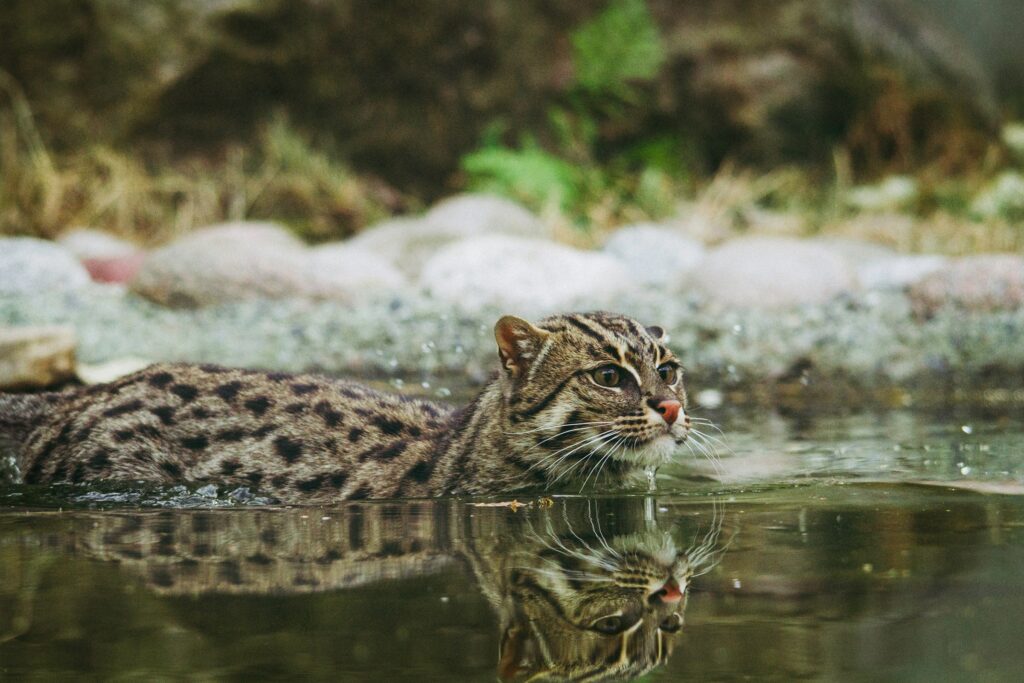
The Fishing cat has a very fishy diet. This medium-sized wild cat is also an adept swimmer catching its own fish for breakfast, lunch, dinner and supper!
While it is not unusual to see a cat munch on its favourite fish it is rare to see a cat actually catch its own fish. In fact, the cat we usually see around, or the domestic cat and the fish has a very unusual relationship. One is averse to waters whereas the other dies when away from it. How these two got entwined in a serious relationship is hard to guess and demands some equally serious investigating.
But what may be unusual for the domestic cat is very much natural for one of its many distant cousins – the Fishing cat (Prionailurus viverrinus).
Cats love fish but some also love fishing
Why the fishing cat was given such a name is evident from its behaviour. The fishing cat is a wild cat that actually fishes its own fish for breakfast, lunch, dinner and supper. They live in marshy areas of South and Southeast Asia. The fishing cat does not shirk away from diving headfirst into water to hunt down the fish it has fixed its target on. In fact, it is an adept swimmer quite unlike other wild cats that rely mostly on land animals for food. It is amusing but not shocking to know at this point that fish composes more than 60% of the fishing cat’s daily diet.
Fishing cat: Adaptations for a life around water
The fishing cat has adapted to a life by the water’s edge. The most striking feature that separates the fishing cat from the rest of the cat family is its webbed paws. The skin between the toes forms a webbing that enables it to swim in the water. The fishing cat has semi-retractable claws, or their claws do not retract fully into their paws. This helps them catch slippery and scaly fishes.
Another unique feature of the fishing cat is its rather small and stubby tail since the felid doesn’t need much balancing to do when on land as most of its time is spent in and around water. Its streamlined body and short tail reduce friction when underwater.
With all this time spent underwater there must be a mechanism to keep dry for no felid can afford to stay wet that long. The fishing cat has a thick dense layer of under fur to keep itself dry and warm.
The fishing cat is nocturnal by nature. Competition from larger daytime predators has probably restricted the fishing cat to only a night-time patrol. Advantages of fishing at night must have prompted the fishing cat to stick to a nocturnal schedule. Fishes are most vulnerable at night due to poor visibility and hence cannot spot predators properly. Thus, they are easy to catch at night.
The animal is solitary meeting only for mating. They also tolerate each other’s company sometimes when sharing the same spot for fishing.
Fishing cat: Hunting strategy in the marshes
When by the water’s edge the fishing cat gently touches the surface of the water with its paws luring fishes to the spot. The fishes mistaking the ripples for insects walking on water approaches the surface and gets scooped out of the water by the predator. The webbed paws come in handy when picking fishes out from their natural habitat.
The fishing cat employs the sit-and-wait strategy to hunt. The felid waits patiently by the water body and when the prey is close by they dive into the water, catch hold of it and swims out of the water fish in mouth.
Why the Fishing cat chose fish over other animals as prey?
A fishy diet has many advantages over other sorts of meat. First, fishes are easy to subdue compared to other small prey like birds or rodents. So, the fishing cat conserves a lot of energy here. Moreover, fish protein is easy to digest and extremely nutritious. Fishes are easy to handle too. The scales are excreted as scat and there aren’t many bones to manage.
Competition from larger felids forced fishing cats to a nocturnal life which they turned to their advantage by choosing fish as prey. Poor visibility at night makes fishes vulnerable hence turning them into easy prey for the fishing cat.
Fishing cat: A declining population
The Fishing cat (Prionailurus viverrinus) is placed in the Vulnerable category in the IUCN Red List. The leading reason behind their declining numbers being habitat loss. A loss of wetlands accompanied by expanding human habitations and climate change are pushing fishing cats towards the brink of extinction in the wild. Since 1970 a total of approximately 22% wetlands were lost globally.
Conflict with humans is one major cause. Shrinking habitats and shortage of appropriate fishing spots force fishing cats to enter human settlements. They steal fishes out of fishing nets and small birds like chickens or ducks from farms. Villagers often kill them for hampering their livelihood. Illegal exotic animal pet trade is another reason why fishing cats are disappearing. They are often targeted for their fur, skin and meat by poachers.
Since fishing cats are nocturnal, artificial light at night (ALAN) from human settlements and other installations force them to venture during the day where they fall victim to competition from other larger predators.
Conservation efforts are undertaken and local people are being educated about the behaviour of the fishing cat to mitigate human-wildlife conflicts in regions where the fishing cat inhabits. However, drastic changes are needed, and natural habitat conservation should be the main motive if the fishing cats are to thrive. When habitats are protected and healthy ecosystems flourish species survival is ensured.