
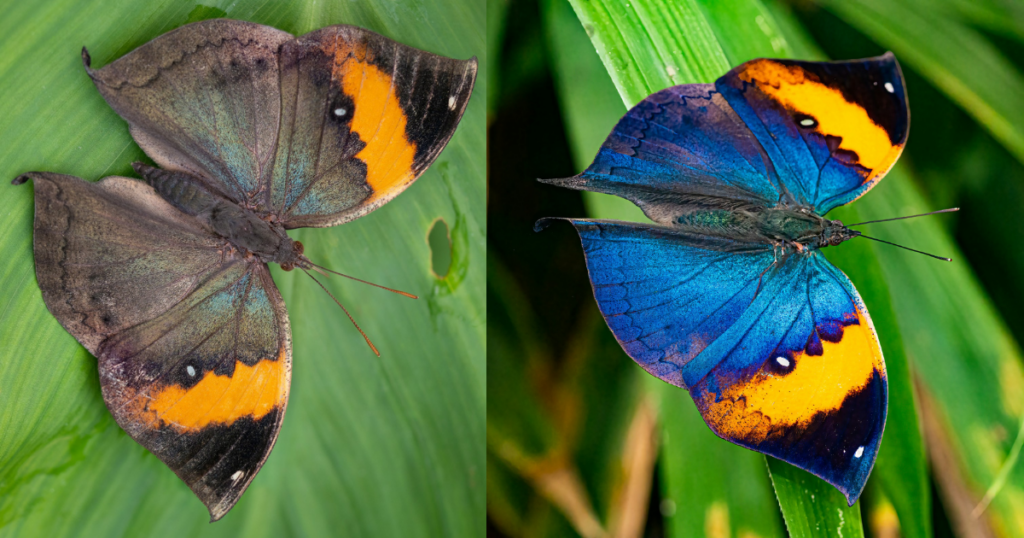
Butterflies in the tropics are generally thought to be more colourful than those in the temperate zones. However, scientists have more to say about the real ground scenario.
When the first batch of European naturalists set out on voyage and landed near the tropics, they were astonished to see the diversity of flora and fauna living in the dense jungles they discovered. Among the many gems that caught their eyes were the stunning bright colours and intricate patterns on the wings of the different species of butterflies found there. This observation led to the establishment of a general opinion that butterflies in the tropics were more colourful than butterflies in the temperate regions.
After years of curating thousands of museum specimens the temperament began to shift. Doubt took root and later naturalists, with access to a wide array of museum specimens for comparison right before their eyes, questioned the basis of the established opinion regarding butterfly wing colour. They argued that although there were many colourful tropical species of butterflies there were equally high numbers of dull coloured butterflies to tip the balance off.
Today we need not depend on the accuracy of the human eyes, prone to observational bias, to compare the chromatic quality of the colours on the wings of butterflies inhabiting tropical and temperate regions. With high end cameras and latest software, it is not difficult to perform an elaborate colour analysis and end the long standing debate once and for all. Whatever hindrances prevented early naturalists from reaching a common ground in this contentious debate can be overcome with ease under the current scenario.
Research analyses colour quality of butterfly wings
A group of researchers thus set forth to collect evidence that could approve or disapprove the fact – tropical butterflies are more colourful than their temperate cousins.
They photographed curated museum specimens from three different regions of the Americas moving from temperate and sub-tropical regions of the north to as far as the tropical rainforests of South America. Maine and Florida were chosen as the temperate and sub-tropical region respectively while a nature reserve in Equador was chosen to represent the tropical sample in the study. Specimens were photographed from collections of the American Museum of Natural History, New York and Academy of Natural Sciences, Philadelphia.
Sophisticated cameras with the latest technologies and modern age softwares were put to use. Colour saturation, intensity and hue of butterfly wing colours were compared from high quality photographs captured under optimal light conditions.
The family Hesperiidae generally has species that are dull coloured so this particular family was not included in both the temperate and tropical butterfly specimen lists. Excluding species that are by nature of muted colours allowed focus to be shifted to those species that are generally colourful at both latitudes.
What they found through their research was astonishing. Their work proved that butterflies in the tropics were indeed more colourful than butterflies in the temperate regions.
How the colour of tropical butterflies differed from their temperate relatives?
Three colour parameters – hue, saturation and intensity – were taken into consideration. Hue says which variant of a primary colour is the colour under examination. While saturation is the purity of the colour and intensity means the strength of the colour.
The hue of colour on butterflies did not vary much among temperate and tropical regions. But the tropical butterflies showed a larger variety of hues amongst themselves. For both colour saturation and intensity the tropical butterflies showed a large variety of shades within themselves compared to both the temperate and subtropical butterflies. Interestingly, the mean colour intensity was greatest in the Florida butterflies. Not to forget, Florida has both sub-tropical and tropical climates. Overall, the tropical butterflies of Equador were more varied in their wing colour and brightness which resonates with the hypothesis that tropical species have more striking colours.
Hue, intensity and saturation variables, however, does not analyze how predators see the butterflies. The HSI (Hue, Saturation, Intensity) colour space include the three parameters human vision uses to perceive colour. And, since the confusion regarding the colourfulness of tropical butterflies originate from how the human eye sees colour on butterfly wings, using the HSI colour space was the right choice.
Why are tropical butterflies more colourful than butterflies in the temperate regions?
It is known that species diversity is highest in the tropics. The same is true for tropical butterflies as well. Approximately 90% of all butterfly species present on the planet reside in the tropics. With so many individuals belonging to so many different species crammed in a narrow belt adorning the belly of the Earth, it must be very difficult to look different. Thus, with the sole motive to look unique from their neighbours and be recognizable to their own kind, tropical butterflies evolved a large variety of colour and pattern on their wings. Sexual selection further worked on the already complex designs on those wings and came up with more colourful patterns. One desperately needs to cook up variety to stay unique and impactful in an environment where everyone is trying something new every other day.
The simple fact that the tropics are more species rich balances all arguments by itself to prove why butterflies in the tropics are more variedly colourful. But pause right there. There is always more to the story.
Come predatory pressure. The tropics are not only teeming with a host of butterflies but also a variety of predators in all shapes and forms that hunt them down and feed on them. Natural selection led to the evolution of different predator avoidance strategies that make use of butterfly wing colours like mimicry, crypsis, warning colourations, wing eye-spots and transparency.
High contrast wing colours give off warning signals telling the predators that the butterflies are either poisonous or distasteful and thus must be avoided. Wing eye spots that perfectly resemble the eyes of larger predators like owls can frighten comparatively smaller predators and are more common in the tropics.
The varied habitat characteristics and rich diversity of flora in the tropics offer a broad colour palette of different substrates to match wings to for butterfly species that employ crypsis as a predator avoidance strategy.
Under dense forest canopies, the dark environment accentuates the development of high contrast wing colours with juxtaposed dark and bright stripes to enhance aposematic signaling. Sunlight leaking through trees create mottled light patches on the forest floor. Butterflies with blotched wing patterns easily camouflage in such environments.
But colours are fading from the wings of butterflies
The stunning colours on the wings of tropical butterflies emerged through a variety of mechanisms over millions of years. They are still evolving.
A strange event is unfolding among the butterflies living in the tropics. As tropical forests are lost to deforestation butterflies lose their colours. Studies show that butterflies are slowly turning duller as deforestation spread like a disease. At this rate all signs of colour will be lost forever. And this bleaching effect is not just restricted to butterflies. It is happening everywhere, in every sphere of life. The natural world is gradually losing its colour.
Today, tropical rainforests are under threat of deforestation with large patches of the Amazon rainforest already cleared for cattle farming. Rainforests in Borneo are being cut down mercilessly and transformed into monocultures for palm oil production. Logging and spread of human habitation threatens all forested land across the planet. Biodiversity is undergoing an extinction event as we live and breathe at the moment.
The planet is as much a home to all the different species that are still surviving as it is to us. We should know better to stop being the greedy selves that we are and be more compassionate towards the other life forms we share the planet with. If we do not stop now this very greed that is killing off every other life form on the planet will engulf us whole in the future.
Reference:
Adams, J.M., Kang, C. and June-Wells, M. (2014), Are tropical butterflies more colorful?. Ecol. Res., 29: 685-691. https://doi.org/10.1007/s11284-014-1154-1