
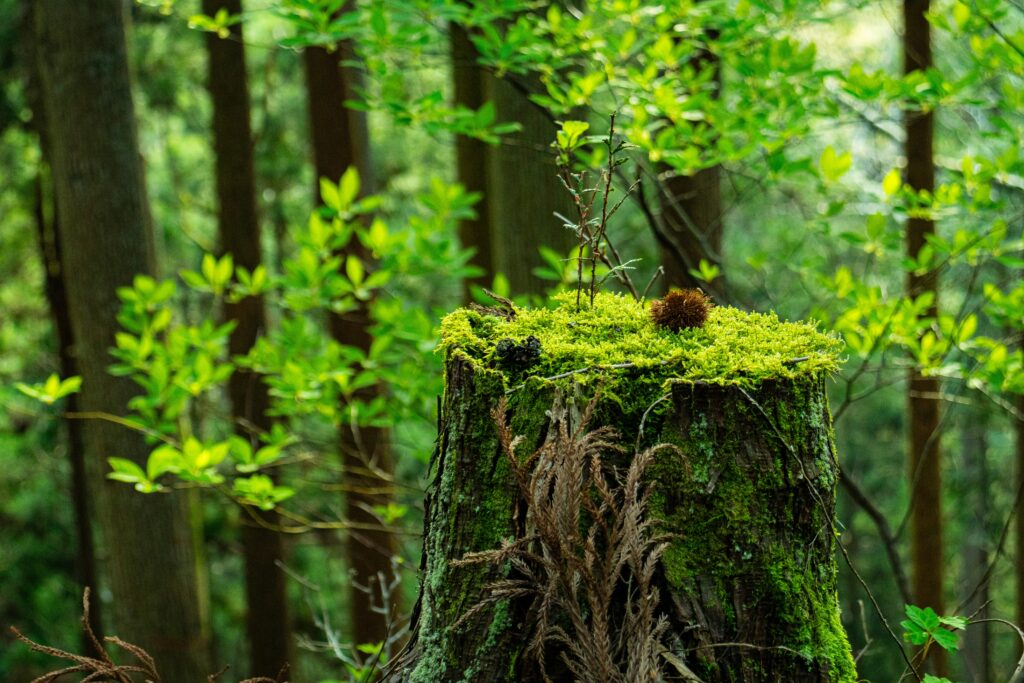
Research finds that trees never really die as stumps are kept alive by surrounding living trees supplying food and water via hydraulic coupling.
Trees are assumed to be solitary entities that thrives on their own. They are the epitome of self-sufficiency. They fetch their own water, collect ingredients for their food on their own and even prepare their daily meals on their own. Not only that, they even produce surplus that feed other organisms.
With this self-sufficient policy in place, trees compete fiercely for resources among themselves. They make sure that their neighbour never out-compete them on the “resource sourcing” department.
In a forest if a large tree is felled by natural forces, the event is a celebration for neighbouring trees. And, why not? It is one less mouth to feed – more sunlight, more nutrients and more water released from occupation and made available for other trees to utilize.
Plants are solitary, self-sufficient, competitive and somewhat selfish. This was the general consensus among scientists regarding plant behaviour and evolution until few years back.
However, research in the last decade or so has revealed much more about plants than previously known. The information has flipped the script about how we see plants as an organism. Plant behaviour is much more complex and deep than previously thought and we are just scratching the surface.
The underground mycorrhizal root network often termed the “Wood Wide Web” is well known. But did you know that tree roots directly connect to one another? And the connection is not limited to the same tree or the same species. Such natural root grafts exist between different tree species too.
We speak of well calculated altruistic favours in animals but something even more intelligent exist in the Plant Kingdom. There is an altrustic side in plants that was never given much importance before and only now are we discovering how profound it actually is.
The root connections we talked about earlier can keep a felled tree stump alive. So, if conditions are favourable shoots can reappear from the stump and the tree can grow back into form.
Not just fungal hyphae but real roots connect trees together underground
Actual roots snap together in what are called natural root grafts to connect trees in a forest ecosystem. If there is a vast stretch of forested area more than 60% individual trees in the population are connected by root grafts.
Self-grafting exist and so does intraspecific and interspecific grafting. The forest community as a whole share the philanthropic attitude towards their mates irrespective of size, shape, colour and race!
Self-grafting is still explainable as it increases stability and promotes better transport of water and nutrients within the tree body. But there is no proper explanation for root connections between different individuals of the same tree species and between trees of different species. Several hypotheses exist. Starting with how natural root grafting helps with better water and nutrient absorption from the soil to how they build greater resistance to strong winds. Even parasitic nature of some trees is explored to explain their occurrence.
How surrounding living trees keep an almost dead tree stump alive?
Intraspecific and interspecific root networks between living breathing trees were still acceptable. What confused scientists even more was how the existing natural root graft network continued to be put to use to keep a felled tree alive when it was supposed to be dead.
After a full-grown tree was felled and reduced to just a stump it continued to record the ebb and flow of sap throughout the day as seen in a living tree. The only differences –
- the sap flow and stem water potential values recorded were much lower than that of a full-grown living tree, and,
- the sap flow direction and stem water potential of the stump followed an inverse pattern relative to the surrounding tall living trees.
In other words, the pulse was still very much present but fainter and asynchronous.
The constant flow of sap in and out of the vessels in the stump kept it alive despite not having living transpiring leaves to either photosynthesize any food or pull water up its still intact root system.
The relationship between the living stump and the tall living tree are mutual though. During the day when the sun is high in the sky and temperatures hot, enough water pull is generated in the tall living trees by evapo-transpiration. These trees benefit from the expanded root system of the stump to draw up water to their leaves and branches. Water flows out of the stump and into the trees. Stem water potential in the stump is at its lowest during this time of the day. But when night falls and the pull of evapo-transpiration ceases to exist, sap flows into the stump supplying food and water to the tissues. Stem water potential in the stump reaches its peak during nighttime.
This flow occurs mainly due to root pressure and osmotic movement where water moves from high potential areas to lower potential areas. During rainy days when evapo-transpiration is extremely low to almost non-existent and there is ample water in the soil, sap flows into the living stump.
Thus, living stumps utilize the high water potential of surrounding living trees during their inactive phases (during night and rains when evapo-transpiration is low) to get its supply of water and nutrients that keep it alive.
As only downtimes in the surrounding living trees are utilized to supply water to the stump, the water status show an inverse pattern to that of living trees. The stump stem water potential has a minima during the day and reaches its maxima at night, quite contrary to the pattern found in living trees.
Good neighbours don’t let trees die
Scientists term the phenomenon “hydraulic coupling” as the neighbouring trees connect physiologically through water movement. It is due to this coupling that trees after being felled stay alive even when fate had sealed its death.
Now you know why new shoots emerge from stumps of felled trees. It is just not its own intact root system supplying it with essential water but the help it receives from its neighbours during its days of crisis. Living trees could have shrunk their root connections and diverted their supplies away from the stump leaving it to die. But they adjusted their water routes around the situation reaching a platform of mutual understanding. Just the reason why trees never really die!
Trees have a sense of community just like humans and other evolved species. Being among the first residents of this planet they have the oldest category of wisdom. It may be different from ours which makes it difficult to fathom but it is highly valuable and should be preserved with utmost care.