
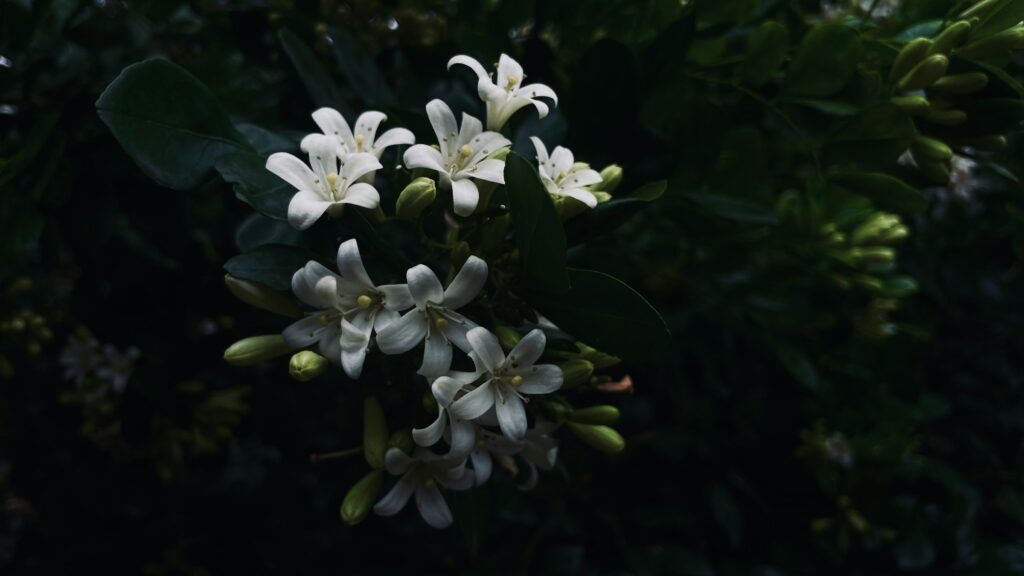
It is a more or less established fact that almost all night-blooming flowers are white or at least pale coloured. And they are fragrant too. But have you ever wondered why?
If you nudge your brain a little you might come up with an answer that sounds something like this, “White is easier to see in the dark as being the polar opposite of black it has the highest contrast, and the scent helps with discoverability”. Well, it is correct. But, you may be right and wrong at the same time here. The logic may sit right for you because according to human vision a white flower is indeed the most prominent thing visible in the dim light of twilight or moonlight or starlight.
However, flowers don’t bloom for us to see or smell. They bloom with a mission, and it is to attract pollinators to the flowers so that they can transfer pollen, fertilize the ovules and make some seeds for the plant.
Plants being intelligent beings, know the sensory limitations of their pollinators and what they find stimulating. This knowledge is exploited to make flowers that exactly suite the taste of the pollinator. Various features are put into play to make a flower attractive to its pollinator starting from colour, scent, shape, size, pattern, nectar content and pollen quantity to tactile stimulatory structures. All of them demand energy and resources.
A plant must make efficient use of its environment to reach an optimal strategy for achieving maximum pollination at the lowest cost possible. The time when a flower blooms also fall under that strategy for it must coincide with a time frame when pollinators are active. Which brings us to the following question.
Why choose the night to bloom? The secret of night-blooming flowers
Events on our planet are guided by the activity of the Sun – our main source of energy. Plants and animals have adapted their life activities around the presence of sunlight. The night is a time when both the plant and the animal world must sleep. However, a whole other world awakes after the sun sets.
Most nocturnal animals are victims of competitive exclusion, displaced by their more powerful diurnal competitors. Some others choose the night to avoid daytime predators. Being displaced to the nighttime to carry out their vital activities they have developed adaptations to fare successfully through the dark hours.
Similarly, many flowering plants have played opportunistic to avoid heat and water stress of daytime by choosing the night as their preferred time to bloom. Together the flowering plants and their pollinating animals have created a nocturnal pollination niche that still remain highly understudied.
A sneak peek into the logic behind flower colours
All angiosperms or flowering plants co-evolved with pollinating insects. The diversification and later success of angiosperms depended mostly on their ability to exploit pollination services from different insect species in varied habitats across the planet. The flower and its pollinator thus have a mutual relationship. How a flower appears, its colour, shape, size, or when it blooms, or the chemical make-up of its nectar and scent, all in theory should be aimed at pleasing the pollinator.
Plants evolved to make flowers that suit the visual sensory spectrum of pollinators. But there are other constraints too and sometimes it’s the pollinator that adapts itself to the flower.
How colourful is the night? The mystery behind the lack of colour in night-blooming flowers
The colour of an object depends on two things. One is the colour spectrum of the light and, two the nature of the light reflecting surface. The nature of light changes a lot as day transition into night. Illumination levels drop several degrees of magnitude as the sun sets beyond the horizon. Light levels on a moonless night and a full moon night differ in brightness by 100 times. Moonlight is similar to sunlight due to the fact that it is just reflected sunlight, but the moon absorbs much of the UV and the properties of our atmosphere especially the ozone layer make moonlight red shifted. Even starlight has more red wavelengths due to the very same properties of our Earth’s atmosphere and the large numbers of red dwarfs in the Milky Way that emit longer wavelength red lights.
Most night blooming flowers are white or pale and lack UV reflectance (so they are not actually insect white!). UV absorbing flower pigments protect delicate reproductive parts from UV damage. Since UV light is almost absent during the night, night-blooming flowers have no requirement for them. And same goes for UV reflecting structures as well. Other flowers that stay open through the night have colours ranging from blue, purple to yellow.
Nocturnal pollinators include vertebrates like bats, lemurs, marsupials, rodents and insects like moths, bees and beetles. Evidence for nocturnal colour vision has been found only in moths and bees.
Nocturnal colour vision was first understood in the elephant hawk moth (Deilephila elpenor). Like bees, the elephant hawk moth has three types of photoreceptors – blue, green and UV. With its trichromatic nocturnal colour vision the elephant hawk moth could differentiate between colours even under the dimmest starlight. Other hawk moth species were also found to have three types of photoreceptors. Hence, presence of trichromatic night vision could be a possibility within this group of nocturnal insects. The results were similar in another nocturnal pollinator, the carpenter bee Xylocopa tranquebarica.
Costly pigments! Why night-blooming flowers avoid them?
Producing pigments is an energy demanding process and plant pigments have roles other than just visual communication. They provide protection against UV damage and herbivory.
The colour of a flower depends on the light environment. Different environments influence flower colour differently. For example, the light environment under a canopy has more green wavelengths which influences pigment production in the flower. Flowers that bloom in the afternoon or evening are mostly yellow or orange because the sunlight near sunset has more red wavelengths and they make the flowers look bright red or orange.
Under the dim light conditions of night-time and absence of UV radiations colour is unnecessary. Other floral features gain importance over colour to attract pollinators. Features like flower shape, flower temperature, scent and nectar rewards take center stage and synthesizing expensive pigments clearly seems like a waste of resources.
Other abiotic factors also play major roles in determining flower colour.
Abiotic factors influence flower colour and blooming time (even in night-blooming flowers)
Abiotic factors like temperature, water availability, day length, UV radiation, soil chemical structure all influence flower colour and blooming time of plants inhabiting a region.
Plants will avoid blooming at a time when temperatures are high and water loss from evapotranspiration is highest. Since flowering is an energy demanding process in itself plants choose a time most efficient when both pollinators are available and environmental conditions are favourable for maintaining the flower. A study found that most night-blooming flowers occur in drier regions.
Anthocyanins (plant pigments in the flavonoid family), give flower their colours like red, orange, pink, purple, blue and bluish-black. Other than pigmentation they have another role i.e., protecting delicate plant structures from UV damage. Their biosynthesis increases with day length, sunlight and UV radiation. Higher precipitation on the other hand lowers anthocyanin production. So, in regions with high solar radiation and drought conditions flowers are more brightly coloured. Higher anthocyanin concentration also deter herbivory and preserves valuable flowers in regions where resources are already scarce. It maybe that absence of UV radiation at night selected for white or creamish coloured night-blooming flowers as there was no need to synthesize pigments for UV protection.
How well does a white flower fare at night?
Most nectar feeding bats have dichromatic vision or have switched to a monochromatic vision down the lane of evolution. Pale or white night-blooming flowers do present a high achromatic contrast in dimly lit surroundings. Even nocturnal moths seem to prefer them. White shows the least variation in contrast under changing illumination levels from dusk to dawn. In one experiment, nocturnal hawkmoths preferred white artificial flowers under lowest illumination but moved to blue as light levels increased.
It is believed that diurnal hawkmoth species switch to achromatic vision at night and back to chromatic vision during the day. If such is the case, then white or pale coloured flowers definitely fare well at attracting nocturnal pollination services.
Scent is extremely important for night-blooming flowers
Night-blooming flowers are more strongly scented than their closely related day-blooming relatives. Since light levels are so low at night flowers rely on fragrance to advertise their location to its pollinators. Moths and bats, the main nocturnal pollinators, have strongly developed sense of smell and plants exploit this sensory affinity to attract them to its flowers.
Flower colour comes secondary to scent as scents can be received over long distances while colour only becomes important at close distances. In the low light conditions of night floral scents become all the more necessary to find a flower. Visual nectar guides are absent in night-blooming flowers, but olfactory nectar guides are present in many night-blooming flowers. This informs us that visual communication is not so important at night and olfactory cues take center stage.
Conclusion
The nocturnal pollinator network remains understudied due to various difficulties in carrying out fieldwork. More intense studies are required to understand it fully. Further research might reveal other aspects to floral morphology and pollinator adaptations in the nocturnal niche.
However, the nocturnal niche is fast disappearing due to human activities. Artificial light at night is the major driver behind declining nocturnal insect populations. For more information on effect of ALAN on biodiversity decline read our article – Lights, camera and missing in action! How Artificial Light at Night is turning an once lively animal nightlife into one of death and oblivion.
Even air pollution is interfering with the olfactory ability of insects negatively affecting their foraging, reproduction, territory defense and other important activities that depend on receiving olfactory cues. The situation is worse at night when air pollution prevents nocturnal pollinators from smelling flowers.
At this rate it seems many treasures of nature (including nocturnal life) will disappear even before we have a chance to learn about them. It’s high time we start taking the ongoing biodiversity loss seriously and hold ourselves accountable for it. We must remember that there is no Planet B – the Earth is our only home.